

Let’s get one thing out of the way: Osamu Tezuka’s Cleopatra is not your average historical epic. It’s also not your average anime. It’s… well, it’s what happens when the “God of Manga” watches Barbarella, chugs a vat of sake, and says, “Let’s do Ben-Hur, but horny and in space-time.”
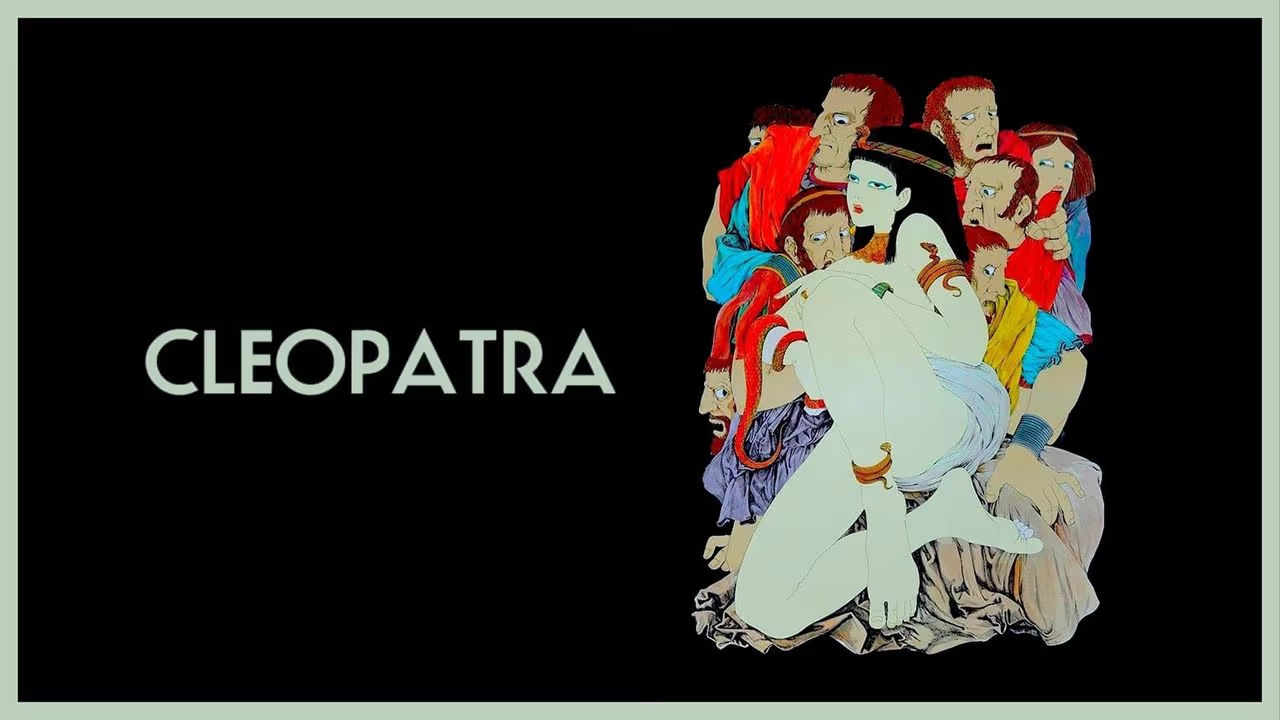
Released in 1970 as the second film in Tezuka and Yamamoto’s Animerama trilogy — sandwiched between A Thousand and One Nights and Belladonna of Sadness Osamu Tezuka’s Cleopatra is part psychedelic head trip, part horny history lesson, and all chaos. What starts as a sci-fi time travel plot quickly dives headfirst into ancient orgies, intergalactic seduction schemes, and Romans wielding handguns, because why not? The animation swings wildly between gorgeous, experimental, and downright crude, while the story tries to juggle satire, sex comedy, and Shakespearean tragedy, usually all in the same scene.
 Subtlety is not on the menu.

As for the plot, our story opens in the distant future, where three scientists—Jirō (Nobuo Tsukamoto), Hal (Tsubame Yanagiya), and Maria (Jitsuko Yoshimura)—have discovered a cosmic threat known as the “Cleopatra Plan,” devised by a sinister alien race called the Pasateli. Their solution? Shove their minds back in time and into the bodies of people in Cleopatra’s court to find out what the plan is. Jirō ends up in a Greek slave named Ionius, Maria in the form of a handmaiden named Libya, and poor Hal—who only signed up to seduce Cleopatra—gets stuck inside a literal leopard.
 So much for being the galaxy’s greatest lover.

Meanwhile, ancient Egypt is having a rough time of it. Cleopatra (Chinatsu Nakayama), caught in a Roman power struggle, is chosen to seduce Julius Caesar (Hajime Hana) and stab him in the back. After a priestess magically gives her a bombshell makeover, she flees an ambush with her handmaidens and catches Caesar’s eye. Jirō/Ionius busts out of slavery by whipping up hand grenades (naturally) and ends up winning Caesar’s favour, gladiator-style, with a modern handgun. Cleopatra becomes queen, Caesar gets more popular than ever, and that makes Rome’s senatorial elite very twitchy.
 “Did you hear anyone mention the Ides of March?”

Plans unravel when Cleopatra starts enjoying her role a little too much: more silk sheets, less assassination. Caesar is stabbed on cue, and in walks Mark Antony (Osami Nabe), who falls hard for Cleopatra, setting the stage for their doomed love affair and the inevitable Roman smackdown at sea that results in him killing himself. Along comes Octavian (Nachi Nozawa), Caesar’s heir, who is less interested in Cleopatra and more into Ionius. Cleopatra tries the same old seduction strategy, but Octavian is both gay and unimpressed. Note: There is a scene where Cleopatra uses two bananas to illustrate to Mark Antony the unimportance of dick size. If that’s not true love, I don’t know what is.
Filled with grief and betrayal, Cleopatra retreats into the Great Pyramid with her friends and commits suicide via asp, deliriously calling for Anthony until death. We then jump back to the future, where Jirō, Hal and Maria have returned to their future time, but not without consequences. What they’ve learned is ambiguous at best. The final scenes are bleak: the war against the Nekonell continues, and humanity’s self-destructive instincts remain intact. The implication is clear: history is a cycle of lust, power, and ruin. Cleopatra was not just a queen or a woman, but an avatar for desire, exploited by men, by gods, and by history itself.
 Missiles Away!

Like A Thousand and One Nights, Osamu Tezuka’s Cleopatra is a stylistic free-for-all — and not always in a good way. It swings from lush, candlelit tableaux and swirling erotic abstractions to slapstick mayhem, where characters squawk like birds and sprint in full Looney Tunes mode. One moment it’s art-house erotica; the next, it’s Speed Racer on psychedelics. The animation has a raw, jazz-like spontaneity; ancient battles explode in jagged montages, love scenes melt into surreal abstraction, until, suddenly, someone farts or gets clobbered with a mallet. It’s Fantasia by way of a drunk Fellini and Monty Python on fast-forward.
 Why is there a Frankenstein/Mummy hybrid? Cause, why not?

There’s real thematic potential in Cleopatra’s use of sexuality — as power, rebellion, even cosmic danger — but most of it gets sidelined by the film’s relentless urge to titillate. Cleopatra could be a fascinating figure: a woman weaponizing her desire in a world ruled by men and gods. Instead, she’s mostly treated like a walking myth, beautiful, doomed, and frustratingly passive. Compare that to A Thousand and One Nights, where the eroticism is wild, weird, and occasionally liberating. Characters like Aldin get to joke, seduce, and screw their way through a mad desert fever dream. In Cleopatra, sex is slower, sadder, and draped in heavy symbolism. It’s not liberating, it’s ornamental. She isn’t a person so much as an animated painting that the film keeps panning over.
 “Caesar, you live in De-Nile.”

As for the animation, Cleopatra makes some bold and undeniably strange stylistic choices—chief among them, the jarring inclusion of live-action elements and what looks like animation crudely pasted over real footage. At times, it feels like you’re watching an experimental student film that wandered into a big-budget acid trip. You’ll see fully animated characters awkwardly composited into real sets, live actors interacting with toons, and even sequences where live faces are traced or overlaid with animation like some unholy fusion of rotoscope and ransom note.
 Who needs rotoscoping when you’ve got this option?

This isn’t just a gimmick; it’s part of Osamu Tezuka and Eiichi Yamamoto’s larger collage-like aesthetic. But whether it works is another story. Instead of blending worlds, it often rips you out of the narrative entirely. The effect is more alienating than immersive, and it can make the already surreal tone of the film feel even more disconnected. That said, there’s something perversely charming about how fearless it is. Cleopatra doesn’t just bend the rules of animation; it gleefully sets them on fire, eats the ashes, and films the whole thing on a soundstage with a dude in a toga and a cartoon cat.
 Also, don’t ask things like “Why is Caesar green?”

In conclusion, Cleopatra is a mess, but a fascinating, singular, and occasionally brilliant mess. It’s a film that bites off more than it can chew, then starts chewing anyway with its mouth wide open. Historically inaccurate, narratively incoherent, and tonally bipolar, it’s somehow both high-concept and lowbrow at once, like a horny philosophy professor on mushrooms.
Cleopatra (1970)
Overall
-
Movie Rank - 6.5/10
6.5/10
Summary
Is Osamu Tezuka’s Cleopatra a good movie? Not really. Is it worth watching? Absolutely. It’s a relic of a time when animation was testing boundaries and film could be anything — even an erotic sci-fi-historical-absurdist-epic where Cleopatra might be humanity’s last hope against horny aliens.