

The Story of O is a film that explores one of the darker corners of sexuality, where love, obsession, submission and control become increasingly difficult to separate. Based on a notorious French novel, Just Jaeckin’s 1975 adaptation approaches its material less like conventional pornography and more like an attempt to turn erotic decadence into high art, with varying degrees of success. Thankfully, it has enough style, atmosphere and actual filmmaking ability to make the journey considerably more interesting than its rather peculiar destination.

O (Corinne Cléry) is a young fashion photographer who is whisked away by her lover René (Udo Kier) to Château Roissy, which turns out to be less of a romantic getaway and more of an extremely exclusive finishing school for sexual submission. A sort of Hogwarts for BDSM aficionados. There, she is subjected to a regimen of discipline, humiliation and obedience designed to prepare her to serve the club’s male members, and overseen by a stern valet/overseer, Pierre (Jean Gaven). Most people bring flowers and wine when courting someone. René apparently prefers a training programme with uniforms and whips.
 Things we do for… love?

René returns for her, and he takes her back to the “real world” where she resumes her job as a photographer, only now she is doing some of her best work, apparently due to her sexual experiences at Château Roissy. Her change also leads to her attraction to model Jacqueline (Li Sellgren), which leads to an interesting dynamic change. René then introduces O to his much older stepbrother, Sir Stephen (Anthony Steel), and decides that O needs to learn obedience to a man she does not love. Sir Stephen proves considerably more demanding than René, although O eventually convinces herself that beneath all that icy authority there may actually be something resembling love. Romance, apparently, has been redesigned by people who hate Hallmark cards.
 This would make for an interesting postcard, “Wish you were here.”

Sir Stephen sends O to a country house in Samois run by Anne-Marie (Christiane Minazzoli), where her education in submission continues with considerably less emphasis on pleasant conversation. Think of this movie as an episode of Three’s Company only if written by the Marquis de Sade. By the time she leaves, she has endured further punishment, received intimate piercings and been branded with Sir Stephen’s initials. Sir Stephen then reveals that René has fallen for Jacqueline and orders O to bring her to Roissy. O eventually seduces Jacqueline and explains her unusual lifestyle, although Jacqueline quite reasonably reacts as though someone has just explained that their idea of a spa weekend involves livestock equipment.
 Do the words “It’s complicated” suffice?

O is later shared by Sir Stephen with two of his acquaintances, The Commander (Gabriel Cattand) and Ivan (Alain Noury), with Ivan quickly becoming infatuated with her and asking that she be released. O refuses, remaining committed to Sir Stephen. She eventually takes Jacqueline to Roissy, where the newcomer begins her own training, before O and Sir Stephen attend a party at the Commander’s Brittany estate. There, O is presented as a living symbol of Sir Stephen’s possession, dressed in little more than chains and an owl mask. Eventually, O asks whether Sir Stephen would endure the same treatment to prove his love for her. His hesitant “I suppose so” turns out to be a remarkably dangerous answer, as O responds by burning a circle into his hand, giving him an “O” of his own.
 A True Bird of Prey.

Stray Observations:
- We get two different versions of O’s arrival at Château Roissy. I’ve heard of alternate endings, but alternate openings? Apparently, The Story of O wanted to get experimental before the story even started.
- The endless narration assures us that because O loves René, she also loves everything being done to her. We’re apparently supposed to see this as liberating. Instead, it comes across as rather creepy, with the narrator practically doing the emotional heavy lifting.
- René’s idea of introducing his lover to his stepbrother as a lesson in obedience is not exactly the sort of family bonding recommended by most relationship counsellors.
- O willingly goes to the château, motivated entirely by her desire to please the man she loves. What we don’t get is any real explanation for why she’s suddenly comfortable signing up for this lifestyle. Love makes people do strange things, but this is quite the leap.
- Jacqueline initially thinks O’s stories about Roissy are ridiculous, which seems like a perfectly healthy reaction to almost everything that happens in this movie.
- Ivan falls in love with O after spending very little time with her. Apparently, the quickest route to true love is being handed someone else’s girlfriend for an evening.
- The Commander’s party has the atmosphere of a society gathering where everyone forgot to tell the caterer what sort of event this actually was.
 Could this be the Court of Owls?

Watching The Story of O today requires a little historical adjustment. We live in an era of OnlyFans, streaming pornography and virtually every imaginable variety of hardcore material available with a few taps on a phone. In the 1970s, erotic cinema occupied a rather different cultural space. Films such as Behind the Green Door, Deep Throat, and Debbie Does Dallas could be wildly successful despite direction that ranged from indifferent to barely functional and acting that occasionally suggested the performers had wandered onto the set while looking for the parking lot. By comparison, some of them practically qualify as Renaissance painting.
 You won’t find much art in Behind the Green Door.
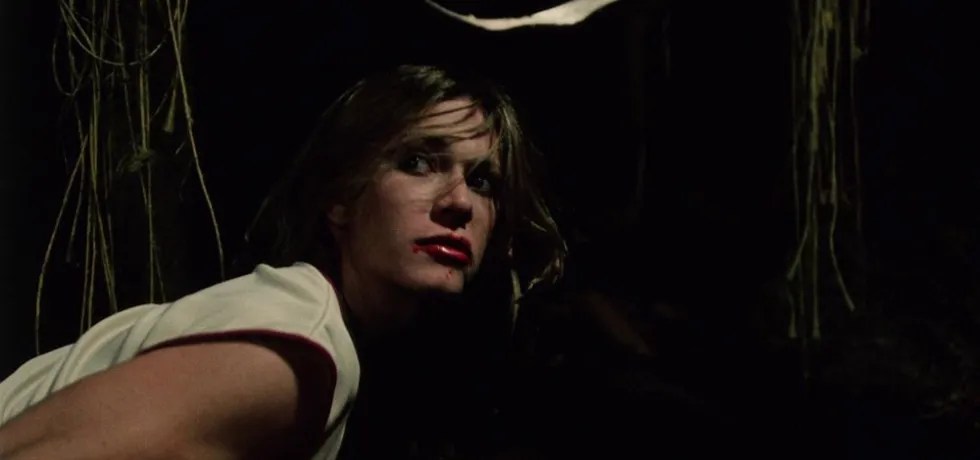
That doesn’t mean American erotic cinema had no artistic ambitions, but those ambitions were hardly the norm. In France, however, the 1970s sexploitation boom produced something considerably more polished. European filmmakers were willing to put respectable budgets, accomplished crews and recognizable actors behind erotic material, resulting in films that could at least pretend they were attending the same dinner party as serious cinema. The Story of O is a particularly good example because Jaeckin approaches the material with the visual confidence of a filmmaker making something intended to survive beyond its original exploitation value.
 This film delivers some heavily charged moments.

The source material was Pauline Réage’s 1954 novel Story of O, published under a pseudonym by Anne Desclos. The book was already notorious for its treatment of sexual submission and power, so adapting it for the screen was never going to produce a gentle romantic comedy about two people discovering they both enjoy brunch. Jaeckin instead attempts to preserve the novel’s atmosphere of psychological surrender while giving the material the sort of sumptuous presentation associated with European art cinema.
 Dinner at Château Roissy is not exactly Dinner with Andre.

Jaeckin had a genuine eye for imagery, and the film’s gorgeous cinematography is arguably its greatest asset. The interiors, costumes, country estates and carefully composed tableaux give everything an elegant, almost dreamlike quality. The production frequently looks far more expensive than it has any right to, and Jaeckin understands that erotic cinema depends as much on suggestion, composition and atmosphere as it does on what happens in front of the camera. The result is a film that often looks like a lavish period drama that has taken a very wrong turn.
 You won’t find this on Bridgerton.

Despite its sadomasochistic subject matter, The Story of O is actually surprisingly soft by modern standards. Much of the sexuality is implied, stylized, or presented through carefully composed imagery rather than explicit detail. That will inevitably disappoint anyone expecting something considerably more hardcore, but it also gives Jaeckin room to pursue his larger ambition of making this feel like a “classic” film rather than merely an extended exercise in exploitation. He doesn’t always succeed, but there are stretches where the eroticism genuinely works.
 We even get a bit of “Girl on Girl Power.”

My biggest criticism is the aforementioned narration. It feels like a crutch, repeatedly telling us what we are already perfectly capable of seeing for ourselves. The film has enough visual confidence to communicate its ideas without someone hovering over the soundtrack to explain them, and the narration often slows down scenes that would be more effective if allowed to breathe. It adds little and occasionally makes the movie feel as though it doesn’t quite trust its own images.
 Does stuff like this need much explanation?

Still, The Story of O is a well-constructed movie even if it isn’t always particularly engaging. Jaeckin clearly wanted to elevate the material above ordinary sexploitation, and the combination of lavish production design, beautiful photography and relatively restrained eroticism gives him enough ammunition to make a respectable attempt. Human beings have apparently been trying to turn complicated sexual obsessions into fine art for centuries, and the French, naturally, decided to put a very expensive camera on it.
 Note: It’s not a proper erotic film if we don’t get a lesbian scene, and in that area, The Story of O does not disappoint. It is simply loaded with sapphic love.
The cast benefits enormously from the film’s polished presentation. Corinne Cléry is stunning as O, possessing the sort of striking beauty that makes it immediately understandable why the camera is so interested in her. She also manages to give O enough vulnerability and uncertainty to keep the character from becoming merely a mannequin being moved from one elaborate tableau to another. Anthony Steel is equally memorable as the enigmatic Sir Stephen, bringing his naturally unsettling screen presence to a character who can shift from sophisticated gentleman to terrifying authoritarian without apparently changing his pulse rate. Then there’s Udo Kier, who could make ordering breakfast sound vaguely threatening, which makes this role rather interesting, as his character is rather wishy-washy. Which is odd for a sadist.
 René is such a tosser.

In conclusion, The Story of O remains an unusual piece of 1970s erotic cinema because it genuinely tries to be something more than pornography dressed up in expensive costumes. The material is undeniably dark, dealing with submission, possession and the increasingly blurred line between love and control, but Jaeckin treats it with enough visual elegance to make the film feel like an actual work of cinema rather than simple exploitation. It is too restrained for viewers seeking hardcore material and too languid for anyone expecting a particularly gripping narrative, while the intrusive narration certainly doesn’t help. But Cléry’s screen presence, Kier’s wonderfully strange performance, the sumptuous cinematography and Jaeckin’s obvious ambition make The Story of O a reasonably successful example of softcore erotic filmmaking. It may not completely transcend its origins, but at least it arrives dressed for dinner.
The Story of O (1975)
-
The Story of O - 7/107/10
Summary
1975 was certainly a good year for erotica with The Story of O and The Image being two great examples of the genre, with both films being beautiful and artful projects, but Metzger’s film is by far the superior one as it truly pushes the boundaries while director Just Jaeckin may have been trying a little too hard to make a “serious” erotic film.