

Somewhere in the early 1960s, American International Pictures looked at a centuries-old fairy tale and thought, “What if we did this quickly and on a budget?” The result is the 1962 Beauty and the Beast, directed by Edward L. Cahn and featuring creature make-up by horror legend Jack Pierce, which at least gives the production a pulse. It’s a curious little relic, equal parts gothic romance and bargain-bin monster movie, trying very hard to feel grand while counting every nickel.

Set in the Middle Ages, Lady Althea (Joyce Taylor) is racing off with her father (Dayton Lummis) to marry Duke Eduardo (Mark Damon), because nothing says romance like an arranged marriage in a drafty castle. Eduardo seems like a decent enough aristocrat at first glance, but naturally, he’s hiding the kind of secret that makes wedding nights awkward. Every evening, thanks to a curse tied to his father’s past sins, he transforms into a wolf-like beast. Althea reacts to this development with surprising composure, as though “My fiancé turns into a monster at sundown” is just another line item in the marriage contract.
 “It could be worse, I could have a small…household.”

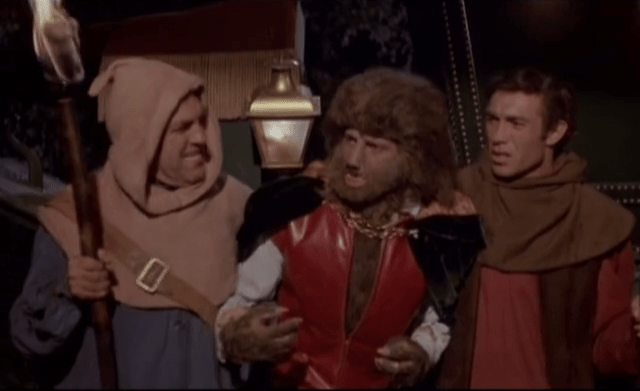
Eduardo, when not busy brooding or growing fur, tries to maintain control of his domain, which is already a stretch given his nightly extracurricular activities. Enter Prince Bruno (Michael Pate), who sees an opportunity and immediately decides that subtle political manoeuvring is overrated. Once he learns Eduardo’s secret, he does what any ambitious schemer would do: first, he attempts to murder Lady Althea, the only person who can lift the curse, but when that fails, he whips the townspeople into a torch-wielding frenzy. Because if history has taught us anything, it’s that mobs are famously calm and reasonable.
 Village mob organizing was a booming business in the 18th Century.

As the villagers sharpen their pitchforks and Bruno nudges events toward full-blown chaos, Althea becomes the lone voice of reason, insisting that maybe—just maybe—the cursed duke isn’t entirely beyond saving. The film leans hard on the idea that love can break the curse, which is sweet and all, but even if that were the case, would you want to then rule over people who were ready to burn you at the stake? Still, the story barrels toward its inevitable climax, where love, violence, and a suspiciously convenient resolution collide in classic fairy tale fashion.
 Love conquers all…again.

Stray Observations:
• The opening credits proudly claim the screenplay is “as suggested by the ancient legend,” which is a bold way of describing an 18th-century French fairy tale. By that logic, last week’s leftovers are a historical artifact.
• Althea adjusts to the “my husband is a werewolf duke” situation faster than most people adapt to a new phone.
• Every night, the Duke clears out his entire staff before sunset, and instead of asking normal questions like functioning adults, they immediately jump to, “Well, he’s obviously in league with Satan.” No investigation, no curiosity, just straight to demonic real estate deals.
• The townspeople go from zero to “burn it down” in record time. No investigation, no questions, just vibes and torches.
• Bruno wants the throne but spends most of his time instigating chaos instead of, you know, governing anything.
• Prince Bruno’s master plan is essentially “Tell everyone and hope they riot.” Shockingly, it works.
 “Anyone know how one deposes a werewolf?”
Edward L. Cahn directs this like a man who knows exactly how much time and money he has left, which makes sense since this was his final film. Cahn was a veteran of low-budget genre pictures, and that experience shows in the film’s efficiency. Scenes move quickly, exposition is delivered without ceremony, and there’s very little indulgence. It’s not elegant, but it’s functional, like a director determined to cross the finish line before the production collapses under its own limitations.
 We do get a nice matte painting of the Duke’s castle.

Cinematographer Gilbert Warrenton, however, tries to elevate things beyond their means. The film leans into shadowy interiors, flickering torchlight, and moody compositions that aim for a gothic atmosphere. At its best, it almost convinces you you’re watching something more prestigious than it is. At its worst, it looks like a well-lit stage play that wandered into a haunted house. Still, Warrenton’s work gives the film a visual texture it probably doesn’t deserve.
 It does have a certain fairy tale aesthetic.

Then there’s Jack Pierce, the man responsible for some of Universal’s most iconic monsters, including Frankenstein and The Wolf Man. His take on the Beast here is less refined than his earlier masterpieces but still carries that signature tactile quality. The design leans heavily into the wolf-man aesthetic, which makes sense given Pierce’s history, though it arguably narrows the character into something more familiar and less fairy tale–mysterious. Even so, the make-up has weight and presence, reminding you that a legend is quietly propping up this modest production.
 “Even a man who is pure in heart, and says his prayers by night…”

As an adaptation, this version sits in an awkward middle ground. It lacks the visual poetry of Jean Cocteau’s 1946 film and the polished storytelling of later interpretations, including the inevitable animated juggernaut that would arrive decades later. What it does offer is a stripped-down, almost pulp take on the material, where romance and horror share space but never fully merge. It’s less concerned with mythic grandeur and more with getting the story told in 80 minutes or less, which gives it a certain blunt charm. Note: The film opened on a literal storybook, a staple opening that the folks over at Disney had been using for years.
In conclusion, the 1962 Beauty and the Beast is a scrappy, imperfect adaptation that survives largely on the strength of its pedigree behind the camera. Cahn’s no-nonsense direction, Warrenton’s atmospheric cinematography, and Pierce’s creature work combine to create something that’s never quite great but rarely dull. It feels like a film caught between ambition and limitation, reaching for gothic romance while keeping one eye on the budget. There’s a sincerity to it, though, an earnest attempt to bring the fairy tale to life even when the seams are showing. It may not stand tall among the more celebrated versions, but it earns a certain respect for trying to do something magical with very earthly resources.
Beauty and the Beast (1962)
Overall
-
Movie Rank - 6/10
6/10
Summary
A low-budget but earnest take on a classic fairy tale, elevated by strong visual work and legendary make-up. Not the definitive version by any stretch, but an interesting curio that refuses to completely fade into obscurity.