

Somewhere between a fairy tale, a therapy session, and a full-on digital spectacle, Mamoru Hosoda’s Belle manages to be both dazzling and emotionally raw. It borrows the bones of Beauty and the Beast and then wires them into a glowing, algorithm-driven world where identity is fluid and trauma has a username. The result is messy, beautiful, and surprisingly sincere in ways most adaptations only pretend to be.

Suzu Naito (Kaho Nakamura) is your standard anime protagonist starter kit: shy, grieving, and emotionally stuck in a loop she didn’t ask for. Living in rural Kōchi, she’s still carrying the trauma of watching her mother sacrifice herself to save a stranger’s child, which has left Suzu with a complicated mix of guilt, anger, and the kind of emotional shutdown that makes high school feel like a spectator sport. She drifts through life with only a handful of connections, including her childhood friend Shinobu (Ryō Narita), who hovers nearby like a self-appointed bodyguard nobody actually hired.
 It’s a bonus him being her secret crush.

Enter “U,” a virtual world where everyone gets a hyper-idealized avatar based on biometric data, because apparently, privacy died quietly off-screen. With some gentle shoving from her genius friend Hiro (Lilas Ikuta), Suzu logs in and becomes “Bell,” a freckled digital pop goddess who can suddenly sing again without choking on her own trauma. Naturally, she becomes wildly famous overnight, because nothing says emotional healing like instant global celebrity and millions of anonymous followers projecting their feelings onto you.
 It’s all up from here…right?

Things take a turn when “The Dragon” (Takeru Satoh), basically the Beast with anger issues and zero PR training, crashes one of Belle’s concerts. He’s being hunted by the “Justices,” a group led by Justin (Koji Yakusho), who has all the energy of a guy who just discovered authority and will not be normal about it. The Dragon is framed as a menace, but Belle, being the only person in this digital circus with a functioning empathy chip, senses there’s more going on. She starts poking around because nothing bad has ever come from emotionally investing in a mysterious, volatile stranger.
 Just enter the wondrous and mysterious castle, it’s all good.

Meanwhile, the real world refuses to be ignored. Popular girl Ruka (Tina Tamashiro), who was the visual inspiration for Belle, confesses her crush on kayak geek Kamishin (Shôta Sometani), and Suzu plays wingwoman like she’s not juggling a secret identity and a growing emotional attachment to a digital rage monster. Back in U, Justin corners Belle and threatens to expose her identity unless she cooperates, which is a totally sane use of power. The Dragon’s AI entourage rescues her, but not before Justin tracks down the Dragon’s castle and trashes the place, because you know, he’s a dick.
 Who wants to bet this dude has a small penis?

The mystery resolves into something painfully real: the Dragon is Kei (Takeru Satoh), a kid being abused by his father, with his younger brother Tomo caught in the crossfire. Suddenly, the fantasy framing drops, and the film decides to hit you directly in the emotional ribcage. Suzu, now fully committed, reveals her real identity to the entire digital world and sings, not for fame but to reach one person who doesn’t trust anyone anymore. It’s reckless, vulnerable, and exactly the kind of thing no one in their right mind would do, which is why it works.
 Unveiling one’s true self is a true moment of courage.

In the final stretch, logic politely steps aside so that emotion can take the lead. Suzu tracks Kei down in real life using a trail of clues that would make a detective blink twice, confronts his abusive father, and somehow manages to protect both boys. It’s not neat, it’s not procedural, and it definitely raises questions, but emotionally it lands. By the end, Suzu makes peace with her mother’s sacrifice, Shinobu finally drops the bodyguard routine, and everyone inches toward something resembling healing.
 This is what a hero is.

Stray Observations:
• The entire platform of U runs on biometric data and nobody seems concerned. Not one “maybe this is dystopian?” conversation. Cool, cool.
• Justin’s whole “I will reveal your identity” thing feels less like justice and more like a guy who got promoted once and never recovered.
• Suzu becomes an international pop icon and still has time to play matchmaker for her friends. Time management skills are off the charts.
• The Dragon’s castle gets burned down and the system just… allows that. The moderation team must be on a long lunch break.
• Suzu deciding to reveal her identity to billions of users is treated as a bold emotional gesture, not a catastrophic privacy decision.
• The adults in the real world are about as effective as decorative furniture until the plot needs them to nod approvingly.
• Tracking down Kei using vague online clues works out way too smoothly for something that should realistically end in confusion and snacks.
 Hiro can hack the planet.

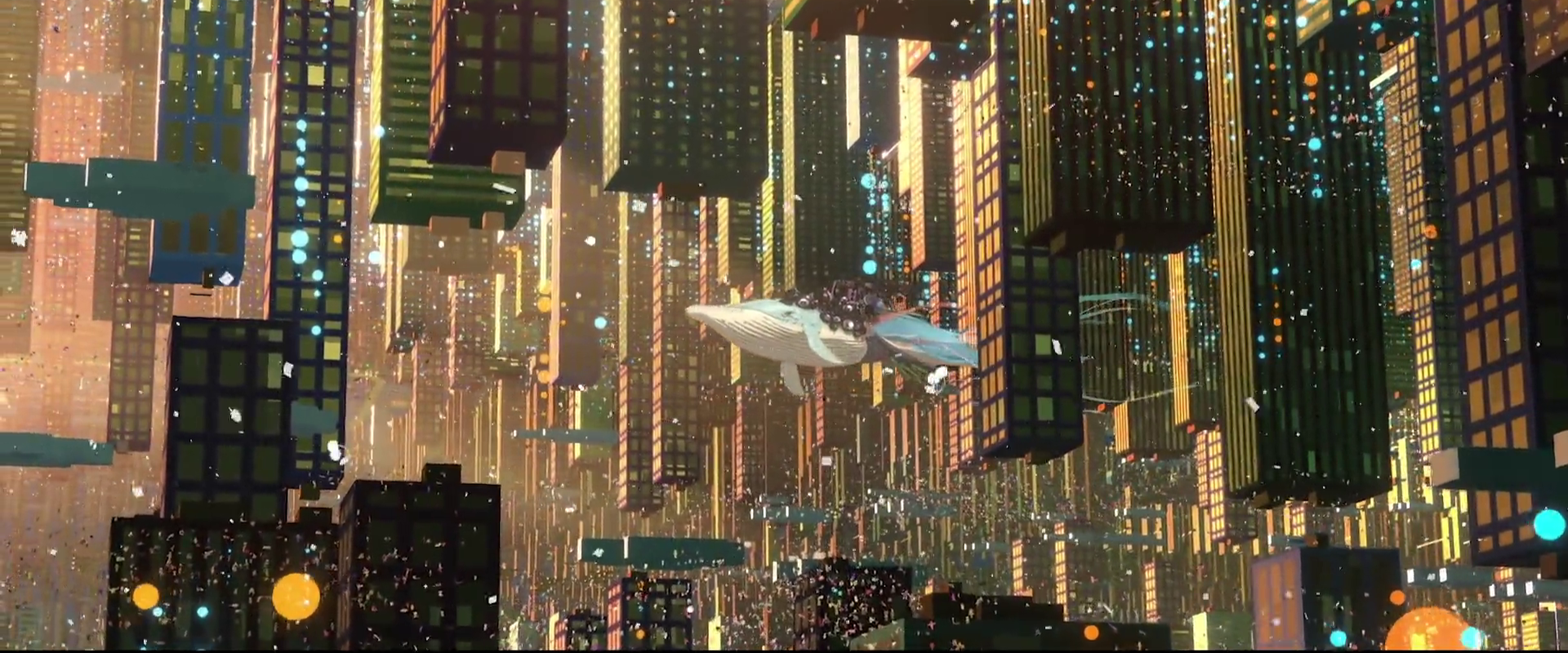
Let’s get this out of the way: this thing is gorgeous. Studio Chizu doesn’t just animate scenes, it builds entire emotional ecosystems. The contrast between the lush, grounded rural Japan and the hyper-saturated chaos of U is where the film really flexes. U feels like someone fed the internet through a dream filter and then cranked the colour dial until reality tapped out. It’s overwhelming in the best way, like the film wants you to feel the same sensory overload as its protagonist, constantly balancing awe with just a hint of digital claustrophobia.
 This movie’s visuals will byte you in the ass.
And then there’s the design work. Bringing in Disney veteran Jin Kim, along with Michael Camacho, to help shape Belle isn’t just a fun trivia note, it shows. There’s a clear visual lineage connecting this version of Belle to the classic Disney heroine, without it feeling like a copy. It’s more like a respectful nod across decades, a reminder that this story keeps evolving but never completely forgets where it came from, even as it wraps that legacy in a much more modern, almost ethereal aesthetic.
 A tale as old as time.

Musically, the film leans in hard, and honestly, it’s about time. Beauty and the Beast adaptations have been oddly shy about embracing full musical storytelling since Paige O’Hara was out there singing about her provincial town like she was carrying the genre on her back. Here, the songs aren’t just decoration, they’re emotional lifelines. Suzu can’t express herself in the real world, but in U, her voice becomes the entire point. It’s not subtle, but subtlety isn’t really the goal when you’re trying to externalize grief through pop anthems.
 The music and visuals soar as only anime can.

Director Mamoru Hosoda brings his usual fascination with digital spaces and human connection, and for once, it doesn’t feel like a lecture. His work often circles around how technology reshapes identity, and Belle might be his most direct swing at that idea. Sometimes it gets a bit tangled, juggling trauma, internet culture, and fairy tale structure like it’s trying to prove something, but when it clicks, it really clicks. The emotional beats land because he commits to them completely, even when the plot mechanics start wobbling.
 This is the rare adaptation where they don’t end up together.

Where does this sit among the long parade of Beauty and the Beast adaptations? It’s not as visually poetic as Cocteau’s Beauty and the Beast, which still feels like a dream someone carefully preserved. It’s also not as polished or universally accessible as Disney’s Beauty and the Beast, which basically became the blueprint for modern fairy tale adaptations. But Belle carves out its own space by dragging the story into the digital age and asking what “seeing the real person” even means when everyone is hiding behind an avatar.
 It’s messier than those versions, but also more willing to take risks.

In conclusion, Belle is one of those films that feels like it’s doing too much and somehow still gets away with it. The plot can get heavy, occasionally collapsing under the weight of its own ambitions, but the emotional core keeps pulling it back together. It’s visually stunning, musically driven, and packed with enough heart to forgive its more questionable narrative shortcuts. For every moment that makes you raise an eyebrow, there’s another that quietly lands and reminds you why this story keeps getting retold in the first place. It’s not perfect, but it’s alive in a way that safer adaptations rarely are.
Belle (2021)
Overall
-
Movie Rank - 8/10
8/10
Summary
Visually spectacular, Belle is an emotionally earnest reimagining of Beauty and the Beast that swaps castles for code and magic for algorithms. Messy in places, but full of heart and bold enough to actually try something new.