

Stories of King Arthur and the Knights of the Round Table have been a staple of literature for generations, inspiring countless retellings that blend myth, history, romance, and tragedy. It didn’t take long for filmmakers to realize the cinematic potential of these tales, and Hollywood has returned to Camelot again and again, drawn to the allure of noble quests, doomed love, and larger-than-life heroes. With such enduring appeal, it’s no surprise that these legends continue to be reimagined on screen, each new adaptation offering its own spin on a story that refuses to fade into legend.

Below you will find a collection of reviews that take a deeper dive into the many cinematic interpretations of the King Arthur legend, a myth that filmmakers have been happily reshaping for over a century, from early silent films to big-budget spectacles and the occasional fever dream dressed up as medieval drama. Some of these films embrace the romance and pageantry of Camelot, others try to ground the story in something resembling history, and a few seem determined to ask, “What if we just made this weird?” The results are, as you might expect, wildly inconsistent, which is half the fun. What follows is a mix of the good, the bad, and the “Who approved this?” All examined in a way that aims to be entertaining, occasionally insightful, and never boring.
To explore these takes on Arthur, Merlin, Excalibur, and the ever-complicated Round Table, simply click on the links or posters below and begin your journey back through the mists of time, where legend, history, and cinematic excess tend to collide.
 A Connecticut Yankee in King Arthur’s Court (1949)
A Connecticut Yankee in King Arthur’s Court is a 1940s musical adaptation of Mark Twain’s classic that stars Bing Crosby as an American blacksmith who finds himself magically transported to the court of Camelot.
 Knights of the Round Table (1953)
Knights of the Round Table is a star-studded picture that focuses on the famous love triangle between King Arthur, Guinevere, and Lancelot, with Mel Ferrer, Robert Taylor, and Ava Gardner portraying this doomed trio.
 The Black Knight (1954)
The tale of The Black Knight derives very little from the Arthurian tales, but it does have Alan Ladd facing off against Peter Cushing, and this alone makes it worth a watch.
 Prince Valiant (1954)
In Prince Valiant, we have a terribly miscast Robert Wagner playing a young Viking prince who must uncover a plot against Arthur’s throne by a mysterious Black Knight.
 Sword of Lancelot (1963)
Also known as Lancelot and Guinevere, this Arthurian film is easily one of the best depictions of that tragic love story which brought down fabled Camelot.
 The Sword in the Stone (1963)
The Sword in the Stone is Disney’s animated retelling of T. H. White’s The Once and Future King and deals with Arthur’s early days under the tutelage of the wizard Merlin.
 Camelot (1967)
Based on the stage musical Camelot by Alan Jay Lerner and Frederick Loewe spends much of its three-hour run-time on the love story and not much else.
 Monty Python and the Holy Grail (1975)
Not only does Monty Python and the Holy Grail wonderfully play with the Arthurian myth, but the Python gang also managed to make one of the funniest movies of all time in the process.
 Unidentified Flying Oddball (1979)
Disney’s Unidentified Flying Oddball is another take on Mark Twain’s A Connecticut Yankee in King Arthur’s Court, only this time putting a delightful science-fiction spin on things.
 Excalibur (1981)
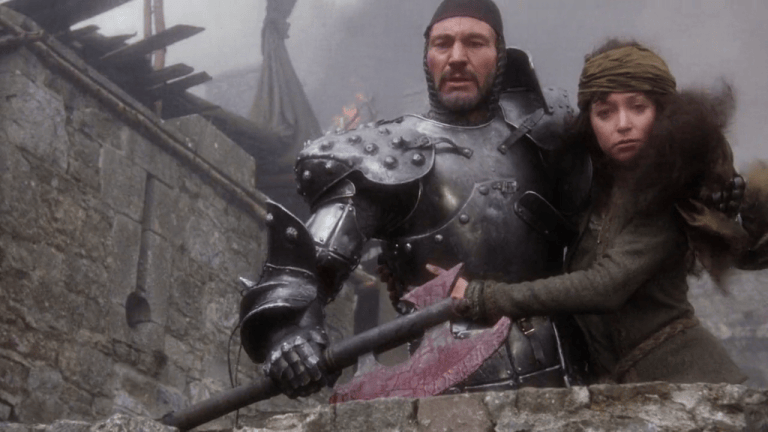
With Excalibur, director John Boorman gives us one of the best adaptations of Thomas Mallory’s Le Morte d’Arthur, in a film that includes up-and-coming stars Helen Mirren, Gabriel Byrne, Liam Neeson and Patrick Stewart.
 Sword of the Valiant (1984)
Sword of the Valiant is a delightfully bad Cannon film that stars Miles O’Keefe as a knight who must solve the Green Knight’s riddle or die. This film is most notable for starring Sean Connery as the incredibly bizarre-looking Green Knight.
 First Knight (1995)
In First Knight, we get a King Arthur story that gives us a rather unbelievable version of the doomed love triangle by having a very miscast Richard Gere at the centre of things.
 A Kid in King Arthur’s Court (1995)
A Kid in King Arthur’s Court is Disney’s second adaptation of Mark Twain’s novel A Connecticut Yankee in King Arthur’s Court and is only notable for starring a young Kate Winslet and Daniel Craig.
 Quest for Camelot (1998)
Quest for Camelot is an animated musical from Warner Brothers that tried to mimic the Disney brand but failed on almost every level in this rather forgettable entry.
 King Arthur (2004)
Antoine Fuqua’s King Arthur gives us “The True Story Behind the Legend,” which makes it another entry in a long line of films that insist on giving us “realistic” interpretations of mythical stories.
 The Last Legion (2007)
The Last Legion follows in the footsteps of Antoine Fuqua’s King Arthur in that it gives us Roman origins for the Arthurian stories and yet is somehow even sillier.
 Transformers: The Last Knight (2007)
In Transformers: The Last Knight, Michael Bay hilariously shoehorns King Arthur and the Knights of the Round Table into this bizarre installment of his Transformers franchise.
 Avalon High (2010)
In Disney Channel’s adaptation of Meg Cabot’s book Avalon High, we find the Arthurian tale being played out in a high school setting.
 King Arthur: Legend of the Sword (2017)
With King Arthur: Legend of the Sword, Guy Ritchie and Warner Brothers hoped to kick off a six-picture franchise, but its big-budget effects spectacularly failed to engage the public.
 The Kid Who Would Be King (2019)
The Kid Who Would Be King is an entry where once again children take up the key roles of the Arthurian saga as they rally to stop the evil Morgana from taking over the modern world.
The above collection of reviews is far from comprehensive, and more are sure to come, but it does provide a clear glimpse at just how often Hollywood has returned to the mythic tales of King Arthur and the Knights of the Round Table, for better or worse. These stories have proven remarkably resilient, endlessly reshaped to reflect the tastes, sensibilities, and cinematic trends of the eras that produced them. Some adaptations capture the grandeur, romance, and tragedy at the heart of the legend, while others stumble in ways that are sometimes baffling and occasionally fascinating in their own right.
What becomes apparent when looking at these films together is not just their inconsistency in quality, but the sheer flexibility of the Arthurian myth itself. It can be epic or intimate, grounded or fantastical, sincere or wildly off the rails, and still remain recognizably tied to the same core legend. That elasticity is likely why filmmakers keep returning to Camelot, convinced that they can finally deliver the definitive version, only to leave the door open for the next attempt. As this collection continues to grow, so too will the long, uneven, and often entertaining cinematic legacy of Britain’s most enduring king.