

Hollywood loves remakes. That adage has never been truer than it is today. Audiences are being constantly bombarded by remakes of older popular films – only if their current hot franchises have run out of sequel steam – and with the cost of making movies today, it is no surprise that Hollywood likes to play it safe and go with what people have liked in the past.
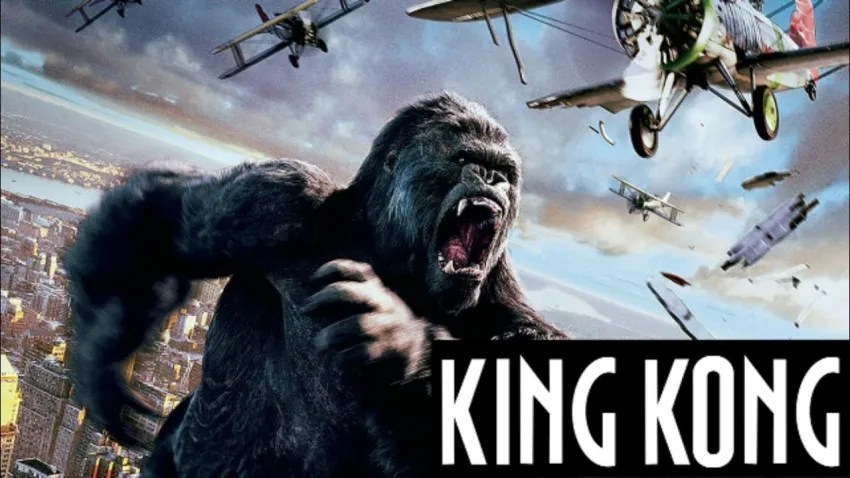
With so much of a modern film’s budget funnelled into marketing rather than production, name recognition has become one of the cheapest selling tools: “Remember that film you loved as a kid? Well, here it is again, only bigger and better.” The 2010 Clash of the Titans is a perfect example, sharing little with the 1981 version beyond the title, yet riding that familiar name straight onto the nostalgia train. So when I heard King Kong was being remade again, I felt equal parts excitement and concern. Would this be another attempt to cash in on fond memories, like the less-than-impressive 1976 version, or something that could truly honour the original while winning over a new audience? The involvement of Peter Jackson, fresh off the success of The Lord of the Rings trilogy, certainly inspired confidence. In the end, my excitement won out. So how does this lavish big-budget epic fare?

Peter Jackson’s adaptation of The Lord of the Rings was an amazing achievement in filmmaking -no one can dispute that – it was an epic in ways that fantasy films had never been able to achieve before, but this, unfortunately, led to Peter Jackson becoming hooked on epics. Tolkien’s three books about Frodo and his friends’ journey across Middle-earth warranted such treatment, but unfortunately not so much a story that was basically an adventure tale about a girl, an ape and an island full of dinosaurs. The 1933 King Kong clocked in at 104 minutes, yet Peter Jackson’s remake is 187 minutes (201 minutes if you watch the extended cut), and that is quite the difference. What can you do with an extra 83 minutes or so? Of course, the original movie didn’t spend much time fleshing out characters; Robert Armstrong’s Carl Denham is the movie’s only really detailed character, so I can understand adding some running time to expand our understanding of the Anne Darrow and Jack Driscoll characters, as Fay Wray mostly screamed and Bruce Cabot was your standard 1930s square-jawed hero. Both did perfectly fine jobs, but one can see how a modern version may want to broaden the canvas a tad.
 “We are going on a three-hour tour…in real-time.”

The story’s basic structure is about the same as the original; depression-era filmmaker Carl Denham (Jack Black) brings a group of people to Skull Island to capture on film something that the natives call Kong. Along for the ride is Anne Darrow (Naomi Watts), a starving actress whom Carl sweet-talks into coming on this crazy voyage. She is sacrificed to Kong by racist stereotypes, a bunch of sailors die trying to rescue her, Jack Driscoll (Adrien Brody) manages to rescue her from Kong’s clutches, and the giant ape follows them back to the village where Denham brings down the ape with some well-placed gas bombs. Kong is taken back to New York City as “The Eighth Wonder of the World,” where he then escapes, rampages across the City, and then meets his end atop the Empire State Building. This is pretty much beat for beat how the original went down, but that simple story was not enough for Peter Jackson; his film had to be bigger and grander, visually and emotionally.
 Also, the expedition is being led by a complete dick.

Robert Armstrong’s Carl Denham was a larger-than-life character, which is kind of awesome, as he was based on the real-life producer Merian Cooper, who was a larger-than-life character. Sadly, Jack Black’s Carl Denham is an asshole verging on being a complete psycho (also borrowing a little Orson Welles persona). After pissing off investors by wasting all their money on stock footage of animals, he wants them to now finance an incredibly expensive sea voyage to an unknown island to film some mythical beast. Strangely enough, they don’t like this plan. Denham is forced to steal footage and props and flee New York City just ahead of a warrant for his arrest. He also traps screenwriter Jack Driscoll onboard the ship so that he will be forced to finish the screenplay. These are not the actions of a sane or even a nice person. When shit gets real on Skull Island, and people start dying, he repeatedly ensures that all the film’s proceeds will go to that person’s widow. We kind of doubt his sincerity.
 Denham is more actiony in this version, but also a much bigger asshole.

The biggest misstep Jackson makes is in having the voyage to Skull Island take 45 minutes. If almost a third of your film’s runtime is just getting to the island, you’ve made a huge mistake, and I just wish somebody had stood up to Jackson and told him, “Nobody is going to give a flying fuck about Jimmy.” For some unfathomable reason, we spend precious screen time with First Mate Hayes (Evan Parke) as he talks to his best pal Jimmy (Jaime Bell) about Joseph Conrad’s novella The Heart of Darkness, and sure there are nice parallels that can be made between the obsessed Kurtz from the book and Denham’s driven filmmaker, but it’s pretty thin and completely unnecessary. Also, if you’re referencing a story that deals with important subject matters such as imperialism and racism, and your film depicts natives in a not-so-flattering light, you may have made an error in judgment.
 I think Jackson mistook Aboriginal people for Orcs.

I know this sounds like I’m shitting all over this movie, but I’m not. I actually quite like the film; it’s just that it could have been so much better if Jackson had shown a modicum of restraint. Turning Jack Driscoll into an intellectual instead of the standard adventure hero was an interesting choice, as was having Kyle Chandler play an actor version of Bruce Cabot from the original, but what works beyond any measure is Naomi Watts as the girl Kong falls for. Naomi’s depiction of Ann Darrow’s relationship with Kong is the heart of this picture and is what makes you put up with the film’s overlong running time. I’ve complained about how the 1976 King Kong reduced the population of monsters on Skull Island to just Kong and a big snake, but if Jackson had left out every other CGI monstrosity from the stampeding brontosauruses to the triple threat T-Rex analogs, and just had scenes between Ann and Kong (Andy Serkis doing amazing motion capture work), this would have still been a great movie.
 Well, maybe keep this scene in as well.

At first Ann is terrified of Kong, as any sane person would be if grabbed by a giant ape, but over a short period of time, she discovers that Kong is simply a lonely animal in need of a friend. When inside Kong’s cave home, we see the skeletons of several giant apes, which suggest that Kong is the last of his kind, and that the whole “sacrifice” nabbing thing is probably something that is now done out of force of habit, and that it’s most likely that both sides of this equation have forgotten the original purpose. It’s when Ann enters his life that there is a break in this ritual, as she cracks open Kong’s hard solitary shell. In the 1933 original, Fay Wray’s Ann wanted nothing more than to get away from this terrifying beast; we still felt sorry for Kong at the end, but not for any chemistry between Ann and Kong. The 1976 version tried to make us believe Ann would scream for Kong to pick her up so that the helicopters wouldn’t gun him down, but other than him giving her a bath and a “blowjob,” there isn’t much to their relationship. With this latest Kong, Peter Jackson has created a pair that are more authentic and heartfelt than I’ve seen in a dozen rom-coms.
 Together these two are simply magical.

Then the army shows up and spoils everything. When Kong finally meets his end atop the Empire State Building, only a person with a heart of stone could not feel the sense of loss and sadness. Civilization had plucked something grand and mysterious from its world, brought it to ours to make a quick buck, and then destroyed it. This kind of sums up humanity over the years, and Peter Jackson’s King Kong perfectly encapsulates that theme. Both previous versions touched on this idea of the rape of the natural world, but only Jackson nailed it. If only he’d trusted that element of the movie and maybe jettisoned much of the film’s chaff. Despite what I said earlier, I do want dinosaurs and the like on Skull Island, but if Jackson had shown a little restraint, that would have been nice. It’s also clear that the bulk of the visual effects budget was spent on the amazingly rendered Kong, but unfortunately, that resulted in some pretty poor CGI for many of the other inhabitants of Skull Island. When will filmmakers learn that over-the-top CGI action isn’t all that thrilling?
 “Be careful, Jimmy, that series of ones and zeroes are about to run you over.”

Peter Jackson’s King Kong is quite the achievement, for Kong alone it deserved every effects award under the sun, but if he’d only trusted the amazing relationship he’d developed between Naomi Watts’s Ann and Andy Serkis’ Kong to hold our interest, and ditched about an hour of unnecessary characters and action beats, this could have been a truly great movie instead of just a very good one.
 Regardless of the film’s length, the ending is worth the wait.

In conclusion, Peter Jackson’s King Kong is the rare remake that justifies its existence, even if it occasionally indulges itself a little too much along the way. Yes, it runs long, and yes, there are moments where the spectacle threatens to overwhelm the story, but when it works, it works beautifully. The film captures the tragic grandeur of Kong himself, delivers jaw-dropping action set pieces, and pays genuine respect to the 1933 original without simply coasting on nostalgia. It may not replace the classic, but it stands tall beside it, offering a modern take that is both ambitious and, at its best, genuinely moving. Not a perfect film, but certainly one worthy of the Eighth Wonder of the World.
King Kong (2005)
-
Movie Rank - 7.5/107.5/10
Summary
The 2005 King Kong remake is certainly an epic retelling of the original story, and the relationship between Ann and Kong is beautifully told here, but if Peter Jackson hadn’t insisted on making it a three-hour extravaganza we could have had something truly special.