

Sometimes Japanese horror goes for ghostly chills, sometimes for kaiju-sized spectacle. 1963’s Matango, however, takes the road less travelled: stranding a group of bourgeois day-trippers on a rotting island and feeding them psychedelic mushrooms until they lose their humanity and their dignity. Directed by Ishirō Honda, best known for Godzilla, this damp, mouldy little nightmare is equal parts survival tale, psychological study, and “Just Say No” campaign ad, with mushrooms playing the role of heroin, LSD, and dessert buffet all in one.
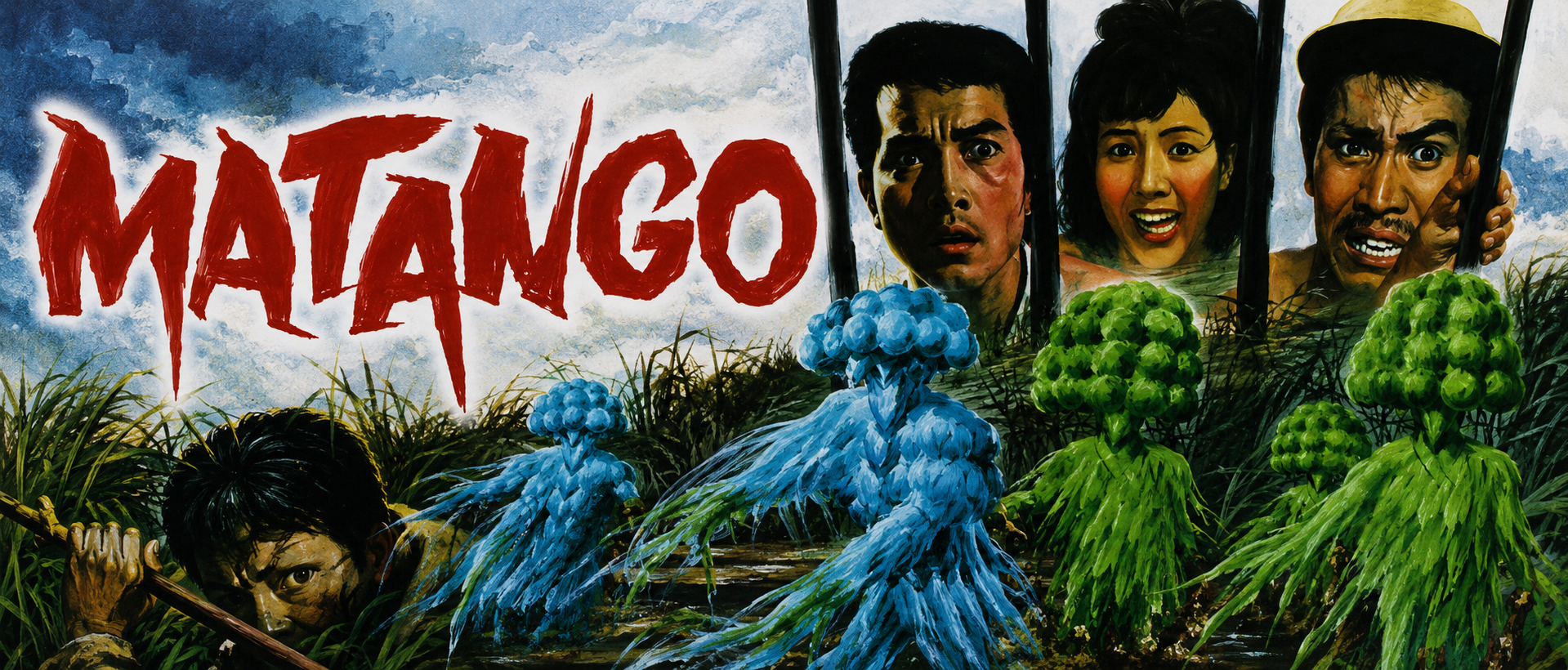
We open in a Tokyo psychiatric ward, where Professor Kenji Murai (Akira Kubo) is being grilled by doctors about how he ended up a gibbering wreck. He tells them his story: he went on a little yacht outing with his friends, because nothing says relaxation like day-drinking at sea with your boss, a spoiled singer, and a smarmy writer. Along for the ride: industrialist Masafumi Kasai (Yoshio Tsuchiya), skipper Naoyuki Sakuda (Hiroshi Koizumi), shipmate Senzō Koyama (Kenji Sahara), celebrity writer Etsurō Yoshida (Hiroshi Koizumi), songbird Mami Sekiguchi (Kumi Mizuno), and wholesome student Akiko Sōma (Miki Yashiro). Naturally, a storm blows in, because nobody in Japanese cinema ever rents a boat and has a nice time.
 Safety Tip: Don’t brag that your boat is unsinkable.

Shipwrecked and hungry, the gang stumble onto an island where the mushrooms are man-sized, the water is fresh, and the vibe is “Gilligan’s Island” if Gilligan had a fungal infection. They soon discover a derelict research vessel, once home to scientists studying the effects of radiation, now transformed into a mouldy mausoleum of bad decisions. The logbook inside, half-rotted but still legible, warns them not to eat the mushrooms. A note, Murai, the resident voice of reason, takes very seriously. He insists the scientists went mad after consuming them. Naturally, no one listens, because otherwise this would just be a short educational film called Mushrooms: Don’t Do It.
 “Could be worse, it could be haunted.”

The cracks in the group widen faster than a mushroom cap in a rainstorm. Kasai hoards the food like a corporate dragon, Yoshida starts losing his grip on reality, and Koyama still dreams of turning a profit even while starving on a deserted island. Soon enough, the crew are at each other’s throats: betrayals, hogtied rich guys, a pistol-waving writer threatening violence, basically, your average yacht party gone wrong. By the time Mami starts luring people into the woods to feast on fungi like a woodland temptress, it’s clear they’re not escaping with their sanity—or their humanity—intact.
 Peer pressure on Mushroom Island.

Eventually, Kasai joins the shroom rave, hallucinating Tokyo nightlife as he munches his way into a mushroom monster. Akiko too, falls to temptation, with Murai desperately trying to pull her back before realizing it’s hopeless. The island’s “residents” are revealed: once-humans, now fungal freaks, swaying in the mist like they’re at an eternal, moist Burning Man. Murai barely escapes by yacht, but the real horror is yet to come: back in Tokyo, he’s already sprouting the first signs of fungus. He concludes, with eerie calm, that humanity isn’t much different from mushroom people anyway. Somewhere in Japan, a PSA about “magic mushrooms” writes itself.
 “Go ask Alice. When she’s ten feet tall.”

Stray Observations:
• Everyone immediately ignores the “Don’t Eat the Mushrooms” rule, which is the entire plot of the movie.
• At one point, the group actually cleans mould off the wrecked ship with cleaning products—as if Lysol is going to save them from radioactive fungus.
• They find one of those Hollywood rifles, the kind that has unlimited ammunition. Sadly, it’s not all that effective against mushroom people.
• Honda originally wanted the mushroom creatures to be more grotesque, but Toho demanded they be softened so they wouldn’t scare children. (As if they weren’t already nightmare fuel.)
• This movie was marketed in the U.S. as Attack of the Mushroom People, which sounds more like the name of a Scooby-Doo episode.
 “We need some meddling kids and a dog.”

Ishirō Honda was no stranger to cinematic catastrophe, but Matango represented a turn toward something far bleaker than giant monster smackdowns. Gone are the city-crushing spectacles of Godzilla or the patriotic optimism of Mothra. Instead, Honda leans into slow decay: an island of rot, a group of increasingly desperate castaways, and the horrifying suggestion that surrendering to pleasure—even when you know it’s self-destructive—might be the most human instinct of all. It’s survival horror before the term existed, laced with postwar anxieties about nuclear fallout and moral collapse.
 Danger: Mad Science at Work.

Hajime Koizumi’s cinematography deserves credit for transforming a single soundstage island into a damp, oppressive purgatory. The mist rolls endlessly, the jungle seems alive, and the shipwreck is one of the great haunted sets of Japanese horror cinema. But while the mood is strong, the special effects are another matter: the mushroom people costumes wobble, bulge, and flap like papier-mâché parade floats left out in the rain. What should be terrifying is instead oddly goofy, which paradoxically makes them creepier, because they suggest bodies and minds warped into grotesque parodies of themselves.
 Lord of the Flies Mushroom Version.

Placed within the larger landscape of Japanese horror in the 1960s, Matango is something of an anomaly. Where ghost stories like Kwaidan and The Ghost of Yotsuya drew from folklore and kabuki tradition, Honda’s film feels firmly modern, even cynical, rooted in the atomic age and consumerist decay. It’s less about revenge from beyond the grave and more about how people, when pushed, will devour each other, or anything they can find. In that sense, Matango is less a horror story than an allegory, and one that feels unsettlingly timeless.
 “Curiouser and curiouser!”

In conclusion, Matango may not boast the spectacle of Honda’s kaiju epics or the elegance of Japan’s classic ghost tales, but it stands as one of the strangest and most haunting horror entries of its era. The pacing can feel a little too deliberate, taking its time to reach the full-blown mushroom people madness, but that slow burn seeps into your bones. It’s equal parts camp, cautionary tale, and bleak moral parable, proving that sometimes the scariest monsters aren’t atomic lizards but the choices we make when we’re hungry, desperate, and surrounded by mushrooms.
Matango (1963)
Overall
-
Movie Rank - 7/10
7/10
Summary
Ishirō Honda’s Matango strands its castaways on an island of temptation, turning them into mushroom men in one of his darkest films. It’s goofy, eerie, and surprisingly profound—a true cult classic of Japanese horror.