

Best known for Astro Boy, Osamu Tezuka also helped create one of animation’s boldest experiments: the Animerama Trilogy. Comprising A Thousand and One Nights, Cleopatra, and Belladonna of Sadness, these films pushed the boundaries of adult animation with sex, surrealism, and social critique. This essay explores their evolution and legacy.
 The Animerama Trilogy

Osamu Tezuka is often called the “God of Manga,” a title that speaks to his outsized influence on Japanese comics and animation. But to think of Tezuka solely in terms of child-friendly icons like Astro Boy or Kimba the White Lion is to overlook one of the strangest and most daring chapters in his career: the Animerama Trilogy. This trio of films represents a bold—and at times baffling—experiment in adult animation. Together, they form a psychedelic, erotically charged, thematically ambitious body of work that straddles the line between art film and exploitation cinema.

The Animerama Trilogy emerged during a turbulent time in global cinema, and Tezuka, ever the innovator, sought to push Japanese animation beyond the domain of children’s entertainment. Inspired in part by European art films and the growing market for adult content, he partnered with director Eiichi Yamamoto and the studio Mushi Production to craft a series of “gekiga” (“dramatic pictures”) aimed at more mature audiences. These films were not just risqué—they were bold attempts to use animation as a medium for psychological, philosophical, and political storytelling.
For a deeper dive into each film in Osamu Tezuka’s Animerama Trilogy, click the posters or links below. Each one will take you to a full, in-depth review exploring the themes, visuals, and legacy of A Thousand and One Nights, Cleopatra, and Belladonna of Sadness individually
 A Thousand and One Nights (1969): A Carnival of Chaos
The first film in the trilogy is also its most eclectic. A Thousand and One Nights is a loose retelling of the classic Middle Eastern tales, reimagined through the lens of 1960s counterculture. The animation is wildly uneven—veering from lush, painterly backdrops to slapstick sequences and crude caricatures—but it pulses with raw creativity. There are scenes of surreal beauty, like a sensual dance bathed in stained-glass light, juxtaposed with bawdy comedy and full-on absurdity.

Tonally, the film is a rollercoaster: it wants to be erotic, comedic, tragic, and metaphysical all at once. The result is messy but compelling, a kind of animated jazz riff unmoored from narrative logic. While Tezuka himself was more hands-on with this installment, Yamamoto’s influence is already evident in the film’s willingness to push boundaries.
 Cleopatra (1970): Sex, Time Travel, and Camp
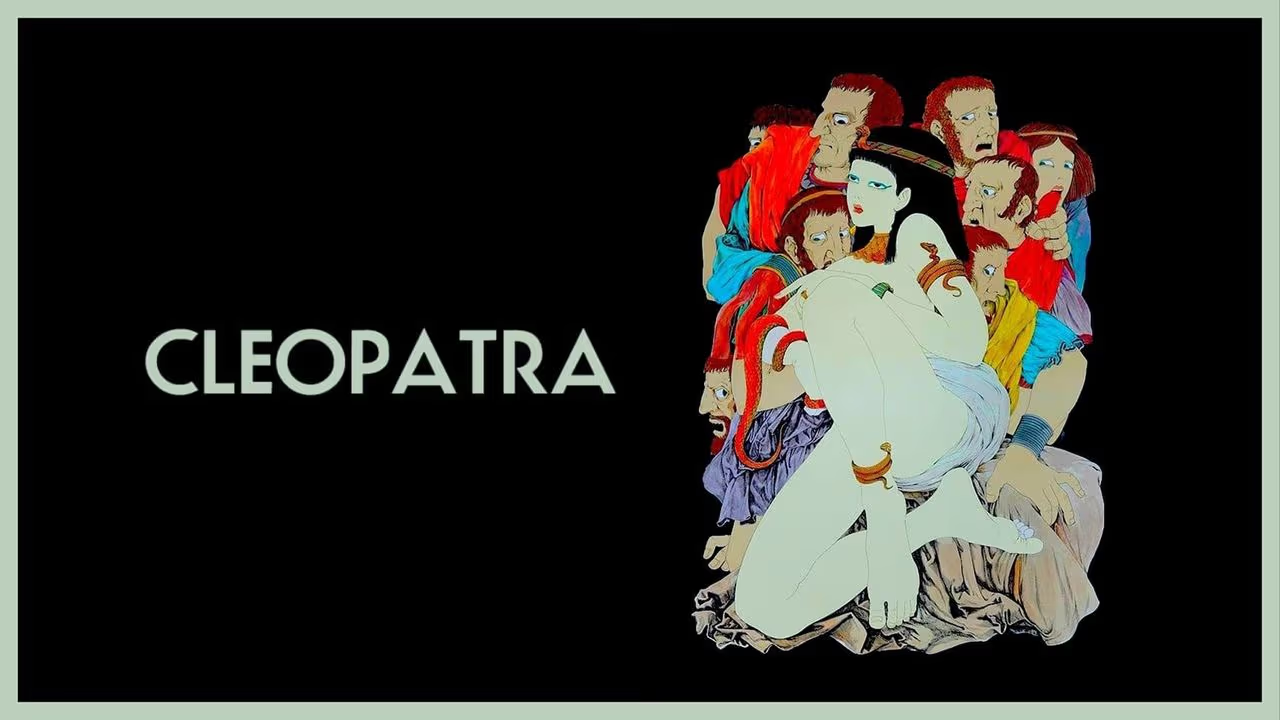
If A Thousand and One Nights was disjointed, Cleopatra is downright bizarre. Ostensibly about the titular Egyptian queen, the film adds a sci-fi wrapper involving time-travelling humans from the future who psychically observe Cleopatra’s life to thwart an alien conspiracy. Yes, really. The plot is incoherent, but that’s almost beside the point. This is a movie where animated characters lounge nude in soft pastel hues one moment, and then suddenly erupt into slapstick violence or musical numbers the next. There’s some thematic potential in its treatment of sexuality—as both a weapon and a trap—but Cleopatra herself, despite her centrality, often feels like a cipher: exoticized, idolized, but underwritten.

Visually, the film experiments with photorealism, live-action inserts, and mixed media in ways that are startling for the time. These stylistic flourishes don’t always cohere, but they reinforce the feeling that you’re watching a fever dream—one that’s equal parts Fellini, Looney Tunes, and Barbarella.
 Belladonna of Sadness (1973): A Masterpiece in Shadows
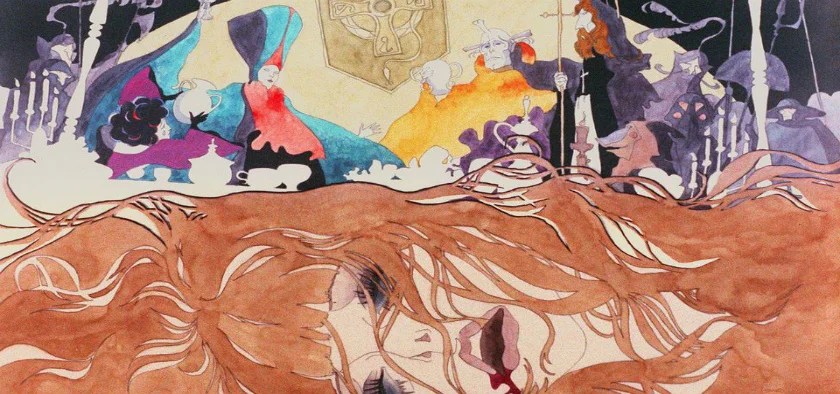
The trilogy’s final film is also its most critically acclaimed—and for good reason. Belladonna of Sadness is less a film in the traditional sense and more a moving painting. After Tezuka left Mushi Production, Yamamoto was given full creative control, and the result is a haunting, slow-burning tragedy rendered in watercolour and anguish. Loosely based on Jules Michelet’s 1862 book La Sorcière, the film tells the story of Jeanne, a peasant woman who is raped on her wedding night and slowly transforms—through trauma, resistance, and a pact with a phallic devil—into a figure of rebellion. The animation is minimalist, often static, using pans across still images, yet it’s visually arresting. The art is symbolic, often abstract, shifting from delicate lines to grotesque distortions that reflect Jeanne’s inner torment.

Belladonna of Sadness sheds the chaotic energy of the first two films in favour of sustained mood, thematic coherence, and emotional devastation. It’s not just an erotic fantasy; it’s a feminist howl. Jeanne is not punished for her sexuality—she’s destroyed for her independence, for daring to exist outside the patriarchal order. And in her destruction, she becomes something transcendent. A martyr. A myth.

The Animerama Trilogy failed commercially and was largely misunderstood in its time. But decades later, these films have been rediscovered as cult classics and trailblazing examples of what animation can achieve. They remain among the few animated works that deal so directly with adult themes—sex, power, gender, rebellion—without reducing them to parody or allegory. Even when they stumble, they stumble ambitiously.

Tezuka’s original vision for adult animation was never fully realized—financial collapse and creative conflicts eventually ended Mushi Production—but the spirit of Animerama lives on. You can see echoes of it in the experimental anime of Masaaki Yuasa, the sensual horror of Satoshi Kon, and even Western animations that dare to aim higher than Saturday morning fare.
Osamu Tezuka’s Animerama Trilogy: Sex, Psychedelia, and the Soul of Animation.
Overall
-
Franchise Rank - 7/10
7/10
Summary
In the end, the Animerama Trilogy is not a perfect body of work, but it is a vital one. It reminds us that animation is not a genre, but a medium—capable of the surreal, the sacred, and the profane. Capable, above all, of confronting the human condition in all its messy, beautiful contradictions.