

Disney’s The Hunchback of Notre Dame is perhaps the most ambitious animated film the studio ever attempted during its Renaissance era. Based on Victor Hugo’s dark and tragic novel, the film dares to tackle mature themes such as religious hypocrisy, persecution, lust, and genocide, all within the constraints of a Disney musical. Yeah, that was always going to be a problem, but could the people at Disney crack such a conundrum?
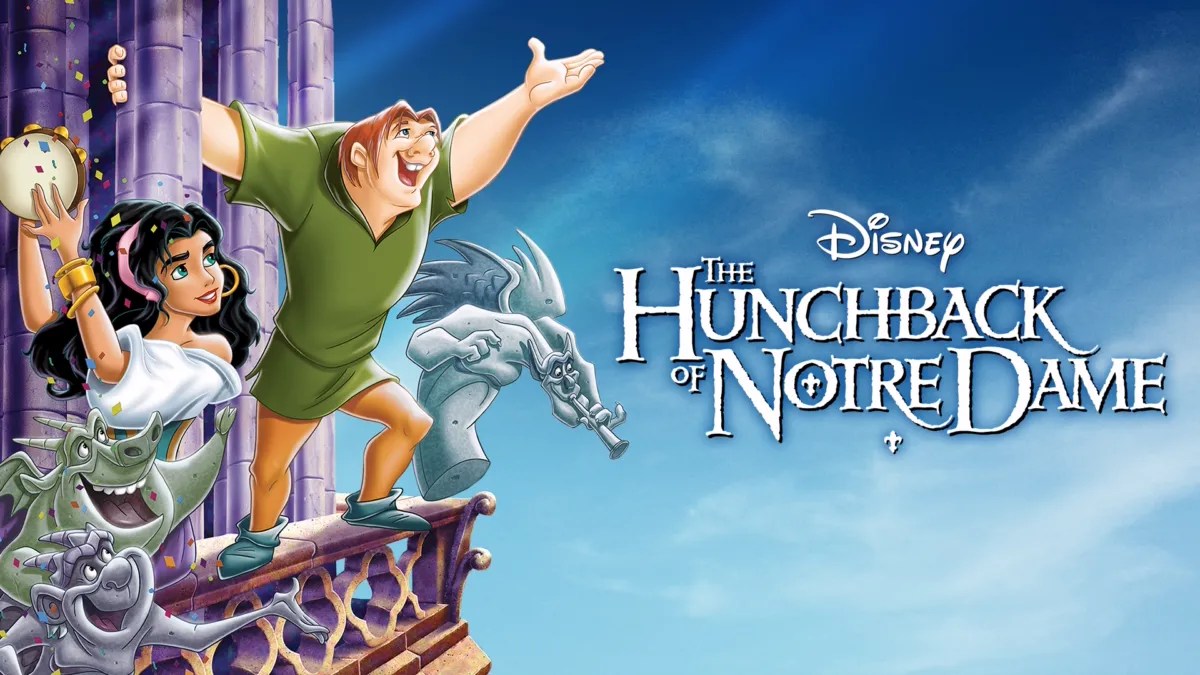
Set in 15th-century Paris, Disney’s The Hunchback of Notre Dame follows Quasimodo (Tom Hulce), a kind-hearted but deformed bell ringer who has spent his entire life hidden away in the Notre Dame Cathedral. Raised by the cruel and self-righteous Judge Claude Frollo (Tony Jay), Quasimodo has been taught that the outside world would never accept him. Despite this, he longs to experience life beyond the cathedral walls. Encouraged by his gargoyle friends: Victor (Charles Kimbrough), Hugo (Jason Alexander), and Laverne (Mary Wickes), Quasimodo sneaks out to attend the Festival of Fools.
 Things go about as expected.

At the festival, he is initially celebrated but soon mocked and humiliated by the crowd. Then, before things can get out of hand, he is quickly rescued by Esmeralda (Demi Moore), a defiant and compassionate Romani woman, who openly challenges Frollo’s authority. Enraged, Frollo declares her a fugitive, obsessed with either possessing her or destroying her. Meanwhile, Captain Phoebus (Kevin Kline), Frollo’s newly appointed soldier, begins to question his leader’s cruelty. When ordered to hunt down Esmeralda and her people, Phoebus defies Frollo, ultimately joining forces with Esmeralda and Quasimodo.
 “We can become Musketeers!”

Frollo eventually discovers the hidden Romani refuge, captures Esmeralda, and sentences her to be burned at the stake. Quasimodo, overcoming his fears, rescues her and leads a rebellion against Frollo’s tyranny. In a climactic confrontation inside the burning cathedral, Frollo meets his demise, and Quasimodo finally steps into the world as a hero. In the end, Paris embraces Quasimodo for who he is, proving that true worth is not defined by appearance but by the heart. Thus, we get a storybook ending where good triumphs over evil with compassion and understanding winning out in the end, basically, a classic Disney animated feature.
 And the children shall lead them.

Where this film stumbles is in its uneven tone. The film aspires to be a serious adaptation of Hugo’s novel, dealing with adult themes in a way that would make even Beauty and the Beast or The Lion King look tame in comparison. However, it’s still a Disney movie, and that means forced comedic elements that clash with the film’s darker moments, with the most glaring offenders being the gargoyles who exist solely for comic relief. Their slapstick antics and out-of-place humour feel jarring against a backdrop of murder, religious zealotry, and societal oppression. The tonal whiplash is never more apparent than in a scene where Quasimodo is publicly humiliated in front of a jeering crowd, followed moments later by the gargoyles cracking jokes about pigeons. The contrast is so severe that it undermines the film’s emotional weight, and for those who haven’t read the book, it may surprise you that there are “No talking gargoyles in Victor Hugo’s novel!”
 “Maybe we were in an earlier draft.”

Needless to say, there are significant alterations between Victor Hugo’s 1831 novel “The Hunchback of Notre Dame” and Disney’s 1996 animated adaptation. While the Disney film is about an unlikely hero who saves the people and city he loves and, in turn, helps us to see people for who they are rather than how they appear, Victor Hugo’s novel is more a scathing indictment of Paris and the people of that era. Below, I’ve listed a few key differences between the Disney film and Victor Hugo’s novel.
 “Sanctuary!”

Tones and Themes:
• Hugo’s Novel: A dark and tragic tale exploring fate, justice, societal cruelty, and the power of the church. It’s heavily critical of medieval Parisian society.
• Disney’s Version: While darker than most Disney films, it’s still a family-friendly adaptation, emphasizing themes of self-acceptance, love, and triumph over prejudice.
Character Differences:
 Quasimodo

• Novel: He is deaf, more deformed, and a tragic figure, utterly devoted to Esmeralda, yet ultimately alone.
• Disney: He’s gentler, more expressive, and remains hopeful, finding happiness among friends.
 Esmeralda

• Novel: A 16-year-old Romani girl, beautiful and kind, but naive. She falls in love with Captain Phoebus and is ultimately hanged for a crime she didn’t commit.
• Disney: An independent, fearless, and compassionate woman who fights for justice. She survives at the end and has a romantic relationship with Phoebus.
 Claude Frollo

• Novel: An archdeacon obsessed with both religious devotion and his lust for Esmeralda, leading him to commit heinous acts that lead to his ultimate downfall.
• Disney: A judge, rather than a priest, who is outright villainous. His religious hypocrisy is toned down, but he remains obsessed with Esmeralda, singing Hellfire, one of Disney’s darkest songs.
 Phoebus

• Novel: A shallow, womanizing soldier who seduces Esmeralda but does not love her. He survives an attempted assassination and lets Esmeralda be executed.
• Disney: A heroic and noble captain who falls in love with Esmeralda and helps Quasimodo in his fight against Frollo’s tyranny.
Treatment of Religion:
• Novel: Religion is depicted with complexity, showing both its corrupting influence (Frollo’s obsession) and its redemptive aspects (Quasimodo’s devotion).
• Disney: The film simplifies the religious aspect, making Frollo a purely evil hypocrite, while religion itself is not deeply explored.
Plot and Ending:
• Novel: The story ends in tragedy. Esmeralda is wrongfully executed, Quasimodo kills Frollo in despair, and he later dies beside Esmeralda’s body, crawling inside her coffin to be with her.
• Disney: The film has a happy ending. Esmeralda and Phoebus end up together, Quasimodo is accepted by society, and Frollo dies in poetic justice.
 The film also adds the obligatory action scene.

So yeah, Disney took a “few” liberties with the source material, but the film’s ending is easily the biggest compromise. Hugo’s original novel is a tragedy, with Quasimodo dying beside Esmeralda’s lifeless body. Disney’s version opts for a feel-good finale where Quasimodo is accepted by society, which, while heartwarming, feels thematically inconsistent with the rest of the film. Up until that point, Hunchback had been about injustice, intolerance, and the cruelty of the masses, yet it ends with the crowd suddenly welcoming Quasimodo with open arms. It’s a resolution that feels too easy, too clean. Also, when he was pouring all that molten lead on the mob, he didn’t seem all that concerned for “friendly fire” as it would have engulfed more than just Frollo’s men. Would that have been so easily forgiven?  Question: Just how much molten lead did they have up on the roof of Notre Dame? This looks more like a volcanic eruption than a siege tactic.
Despite its G-rated label, The Hunchback of Notre Dame delves into surprisingly dark territory, tackling themes of religious corruption, prejudice, genocide, and repressed lust, most notably in the haunting song “Hellfire,” where Frollo battles his own desires for Esmeralda. Tony Jay’s voice performance imbues the character with chilling gravitas, making him one of Disney’s most sinister and complex villains. Meanwhile, Quasimodo’s internal struggle is beautifully captured in “Out There,” a soaring anthem of longing and self-discovery.
There’s no denying Hunchback is one of Disney’s most visually striking entries; it is a stunning film, with sweeping shots of Notre Dame and rich Gothic-inspired animation that give the story a grand, operatic feel. Alan Menken’s score and Stephen Schwartz’s lyrics elevate the film’s emotional depth, making songs like “God Help the Outcasts” resonate beyond the screen. The Gothic architecture of Notre Dame is rendered with a level of detail and grandeur rarely seen in traditional animation. The use of light, shadow, and colour, especially in sequences like “Sanctuary” and “Hellfire”, creates a mood far darker and more atmospheric than typical Disney fare. Note: The “Hellfire” number that explores Frollo’s feelings of lust and shame is the most sexually charged piece of animation the Disney studio ever produced.
Disney’s The Hunchback of Notre Dame is an undeniably bold experiment, and in many ways, it deserves praise for its ambition. It tackles themes that most animated films wouldn’t dare approach, boasts some of Disney’s best visuals and music, and features one of the studio’s most compelling villains. But its inconsistent tone, unnecessary comic relief, and compromised ending prevent it from reaching true greatness. It is a film at war with itself—torn between the desire to tell a mature, weighty story and the need to conform to Disney’s family-friendly formula.
 “Can we fit a few more fart and poop jokes into the script?”

Ultimately, it is an admirable, if uneven, Disney adaptation, one that dares to explore weighty themes and delivers some of the studio’s most breathtaking visuals and music. However, its conflicting tones, balancing mature drama with forced comic relief, prevent it from fully realizing its potential. While not a flawless film, it remains one of Disney’s most daring and thought-provoking works.
 Does Euro Disney have a Quasimodo attraction?

Overall, Disney’s The Hunchback of Notre Dame drastically alters the tone and conclusion of Hugo’s novel, turning a tragic historical drama into an uplifting and adventurous animated feature. Where the novel is a tragic social commentary, the Disney film is a hopeful story about acceptance and love. Both versions explore similar themes but with vastly different tones and endings. While it remains an impressive and often overlooked entry in Disney’s Renaissance era, it ultimately plays things too safe, diluting the novel’s raw power in favour of a more conventional Disney formula.
The Hunchback of Notre Dame (1996)
Overall
-
Movie Rank - 6.5/10
6.5/10
Summary
Disney’s The Hunchback of Notre Dame is one of their ambitious films, boasting breathtaking animation, a phenomenal soundtrack, and one of the studio’s best villains. However, its tonal inconsistencies, unnecessary comic relief, and softened ending prevent it from fully realizing its potential.