

When it comes to bondage and erotica in film, French director Just Jaeckin’s adaptation of author Anne Cécile Desclos’s The Story of O pretty much set the bar by which movies exploring this particular corner of human sexuality would be measured. Over in America, director Radley Metzger took note of what Jaeckin had accomplished and apparently wondered, “Is that what you call sadomasochism?” With that mindset, this American filmmaker, working in the considerably kinkier surroundings of Paris, brought us the film known simply as The Image.
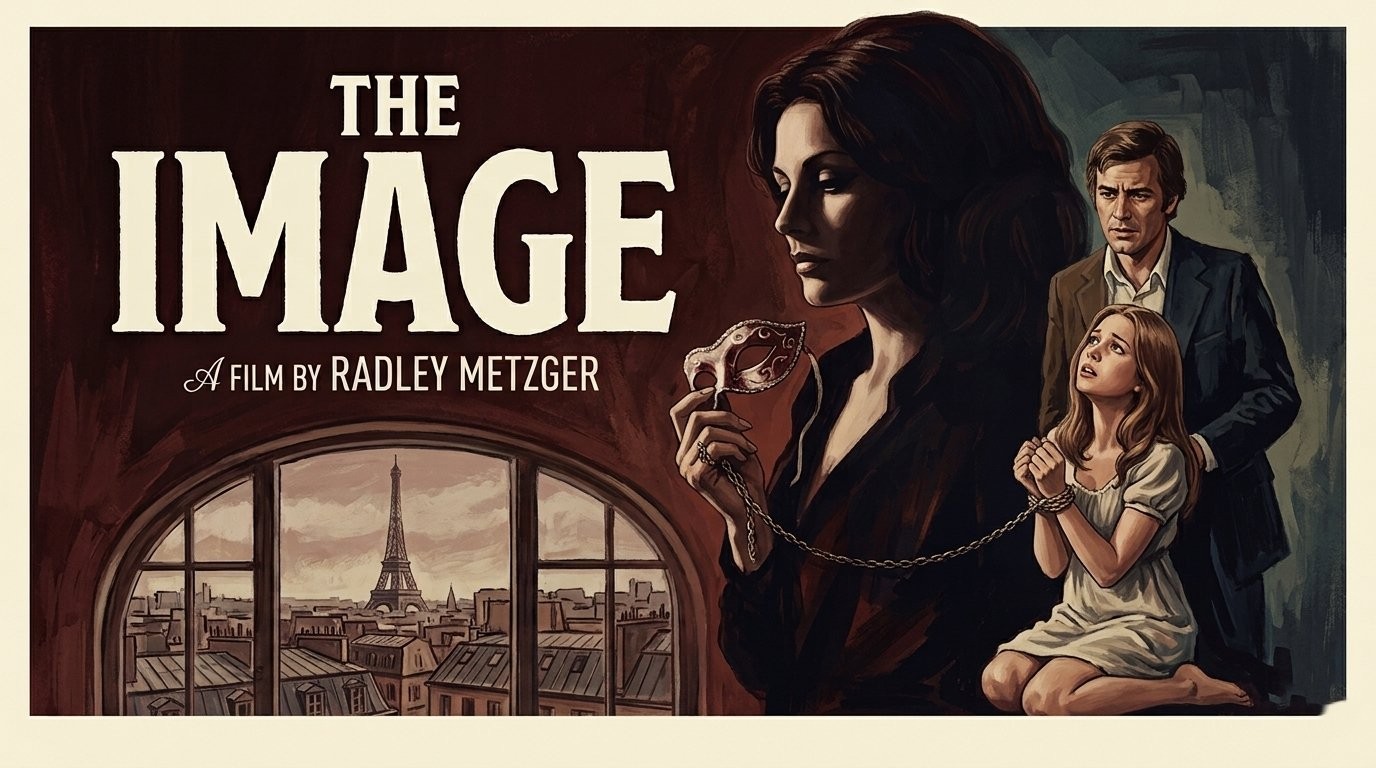
Jean (Carl Parker), a suave but terminally bored writer, attends a wealthy literary party in Paris, where he spots the ravishing Anne (Mary Mendum). Hoping to learn more about her, he approaches Claire (Marilyn Roberts), an old flame, only to discover that she and Anne are lovers. Claire invites him to visit them, setting the stage for an introduction to a world considerably kinkier than the usual literary cocktail party.
 The polite guest who took the host’s hospitality way too far.

Jean soon discovers that Claire is the dominant partner in a sadomasochistic relationship, treating Anne as her submissive plaything and subjecting her to humiliation and punishment. Rather than questioning his life choices, Jean becomes fascinated by their arrangement. Claire is cold, commanding, and seemingly in complete control, while Anne’s quiet obedience hints at desires that may be more complicated than they first appear.
 Just your average, casual afternoon in the Bagatelle rose gardens.

Claire begins inviting Jean to participate, turning their private relationship into an increasingly elaborate threesome. She shares photographs of Anne that fuel Jean’s obsession, and together they explore their fantasies through bondage, sexual humiliation, and physical punishment. Jean moves from curious observer to enthusiastic participant, apparently finding inspiration in places his writing career never could have taken him.
 Establishing a deeply uncomfortable, high-society hierarchy.

Divided into a series of chapters, the film follows their escalating games through private rooms and public settings, where exhibitionism and the risk of discovery add another layer to the proceedings. From bizarre restaurant antics to a lingerie-shopping excursion involving a salesgirl (Valerie Marron), the trio’s activities grow increasingly outrageous. Claire continues orchestrating the encounters, while Jean happily follows along, seemingly oblivious to the fact that he might be just as much a pawn as Anne.
 The moment Jean decides to rewrite Claire’s rules.

As the punishments intensify, Jean discovers that Claire has been directing events with the precision of a filmmaker, manipulating both him and Anne to fulfil her own vision. Their carefully maintained hierarchy finally begins to collapse when Jean’s involvement threatens Claire’s authority. The brutal climax exposes the weaknesses beneath her commanding exterior, while Anne’s response suggests that the supposed submissive may have understood the power dynamics better than either of her partners.
 A final act that delivers total psychological whiplash.

Stray Observation:
- Jean is supposed to be a writer, but his most significant contribution is narrating the obvious. His voice-over is so intrusive that the film occasionally feels like an audiobook whose narrator has wandered onto the set and refuses to leave. The imagery is already doing the work, Jean. Give it a rest.
- A public garden makes an unexpectedly memorable romantic destination. Claire’s idea of an enjoyable outing involves ordering Anne to steal a rose and conceal its thorny stem beneath her garter, followed by an act of public humiliation. Most couples settle for a nice walk and perhaps an ice cream. Claire clearly considers those activities insufficiently ambitious.
- Anne’s apparent helplessness deserves a closer look. She spends much of the film obeying Claire’s commands, but the occasional glimmer in her eyes suggests that she is getting something out of these encounters that her companions might not entirely understand. The film’s power dynamics are considerably more interesting when Anne is treated as a participant with desires rather than merely a beautiful victim.
- The Gothic Chamber sequence is not for the faint-hearted. By this stage, the film has abandoned any pretence of playing it safe, escalating the punishments into genuinely disturbing territory. Anyone who has spent the preceding hour wondering whether things might become a little more extreme can finally stop wondering.
- Jean mistakes access for authority. Being invited into Claire’s private world makes him feel important, but he never quite grasps that an invitation is not the same thing as control. It’s an expensive lesson in the dangers of confusing participation with power.
- Shopping for lingerie becomes an elaborate sexual escapade. Claire sends Jean and Anne out together, and a salesgirl becomes part of the proceedings. One can only imagine the customer-service training required for this particular boutique.
 I would not be surprised if Mary Mendum turned women bisexual daily.

Based on Jean de Berg’s novel L’Image, the film makes no attempt to disguise its intentions, and anyone expecting a coy little exercise in suggestive glances and strategically placed bedsheets has come to the wrong party. This is graphic, uncompromising erotic cinema that pushes well beyond the boundaries of conventional softcore filmmaking, with a decidedly chilly examination of dominance, submission, humiliation, and the peculiar games people play when sex becomes a battle for control.
 1970s foreplay, disguised as a book club.

Radley Metzger was hardly a stranger to sophisticated erotic cinema. Working under the name Henry Paris on some of his adult productions, he had developed a reputation for films that combined explicit sexuality with polished cinematography, carefully composed images, and more narrative ambition than the genre’s less distinguished offerings. The Image benefits enormously from that experience. Shot in Paris, the film surrounds its characters with elegant interiors, fashionable settings, and an atmosphere of privileged decadence that makes their increasingly disturbing activities feel like an extension of their social environment rather than an intrusion from another world.
 Kink, but make it high art.

Metzger also understands the importance of visual composition. Anne is repeatedly framed as an object to be observed, photographed, displayed, and manipulated, reflecting the way Claire and Jean perceive her. The camera’s interest in her physical appearance mirrors the characters’ fascination, making the viewer uncomfortably aware of the relationship between erotic imagery and objectification. This is not an especially subtle film, but its visual intelligence gives it more substance than a collection of increasingly outrageous sexual episodes might otherwise possess.
 This film is not for the faint of heart.

The chapter structure provides a sense of progression, with each new episode extending the established power dynamic and pushing the characters further into their respective roles. Metzger allows the encounters to unfold at a deliberate pace, building an atmosphere of ritual and repetition. The repetition is intentional: the characters are not simply pursuing pleasure but reinforcing a hierarchy through routines that gradually become more elaborate and more disturbing. There is something almost clinical about the way these activities are presented, as though the director were documenting an experiment in human behaviour.
 Claire and Anne redefine the term “power couple.”

Unfortunately, Metzger’s most obvious miscalculation is Jean’s narration, which repeatedly explains what the audience can already see, interrupting the carefully constructed atmosphere rather than adding any meaningful depth. There are moments when I wanted to reach through the screen, confiscate Jean’s microphone, and let the pictures speak for themselves. Still, Metzger deserves credit for balancing the film’s explicit content with a coherent dramatic framework, as the escalating encounters and growing tension between Jean, Claire, and Anne give the story a purpose beyond the next sexual escapade. The deliberate pacing may test viewers looking for a conventional narrative, but those willing to look beyond the graphic excesses will find a surprisingly compelling exploration of desire, manipulation, and control.
 Peak Radley Metzger elegance.

The cast is central to the film’s success, particularly because the characters could easily have become little more than exaggerated stereotypes. Carl Parker’s Jean is so bland that he occasionally threatens to drain the life out of the film, while his intrusive narration explains things the audience can already see. Marilyn Roberts fares much better as Claire, delivering a cold, commanding performance that makes her character’s authority entirely convincing. Roberts also reveals the insecurity lurking beneath Claire’s carefully maintained composure, particularly when her control over the people around her begins to slip.
 Even the architect gets lost in the maze.

is the film’s real revelation. Her performance gives Anne a fascinating ambiguity, with fleeting expressions and subtle changes in demeanour suggesting that her apparent helplessness conceals a more complicated inner life. Mendum makes Anne feel like a person rather than simply an object of desire, leaving us wondering how much of her submission is vulnerability and how much is a choice of her own. Alongside Roberts, she provides the psychological tension that elevates The Image beyond a succession of increasingly outrageous sexual encounters.
 Stunning. Ethereal. Unforgettable.

Just Jaeckin’s 1975 classic The Story of O established an important benchmark for erotic films exploring sadomasochism, submission, and sexual power, but Radley Metzger’s The Image takes a more intimate, psychologically unsettling approach. Rather than concentrating on elaborate rituals and established hierarchies, Metzger focuses on the twisted triangle between Jean, Claire, and Anne, using photography and carefully staged encounters to explore how desire can turn a person into an object. The film also occupies an interesting position between the art-house erotica of the early 1970s and the increasingly explicit adult cinema that followed. Its graphic sexual content pushes well beyond conventional theatrical erotica, yet Metzger retains the polished visuals, deliberate pacing, and psychological ambitions of his more sophisticated work.
 A very literal interpretation of “hard work.”

That combination makes The Image both compelling and decidedly unsuitable for casual viewers. Its sexual humiliations and physical punishments make Fifty Shades of Grey look like an adventurous weekend at a luxury spa, but the film offers more than shock value. It explores control, dependency, and the gap between the person and the image others construct of them, although its own fascination with the human body sometimes blurs the line between artistic ambition and exploitation. That uncomfortable tension is part of the film’s appeal, even if its relentless explicitness and Jean’s godawful narration occasionally get in the way.
 Who needs narration over stuff like this?

The film’s most intriguing idea is ultimately contained in its title. Anne is not merely a woman desired by Jean and controlled by Claire; she is also an image created by the people around her. Claire photographs her, arranges her, and attempts to dictate how she will be perceived. Jean becomes fascinated with the version of Anne that Claire presents to him, gradually confusing his own fantasies with the person standing in front of him. Yet Anne’s performance suggests that the image is never entirely complete. There is always something about her that escapes the other characters’ control, whether it is a fleeting expression, a hint of amusement, or the possibility that her apparent submission conceals a more complicated form of agency. The film’s conclusion gives that idea its greatest dramatic force, exposing the limitations of the very hierarchy that has governed the story.
 The End.

In conclusion, The Image isn’t exactly ideal family entertainment unless you’re looking for an efficient way to empty a room. Its graphic sexuality, humiliation, and escalating violence make it a challenging watch, but Radley Metzger’s direction, Marilyn Roberts’ commanding performance, and especially Mary Mendum’s riveting portrayal of Anne elevate it beyond mere erotic provocation. Jean’s dreadful narration and thoroughly bland personality are frustrating distractions, but the film’s exploration of dominance, manipulation, and the fragile boundary between control and dependency gives it unexpected depth. It’s certainly not for everyone, but The Image remains a fascinating, frequently uncomfortable, and undeniably memorable entry in 1970s erotic cinema.
The Image (1975) - Review
Overall
-
Movie Rank - 7.5/10
7.5/10
Summary
This film may be a little over-the-top for casual viewers, as it drifts very close to being actual porn and not erotica, but one cannot deny that the story and characters are very compelling, all going towards making The Image into quite riveting journey.