

Sometimes a movie comes along that reminds you why drive-ins existed: so that people could make out and not watch the movie. The Navy vs. the Night Monsters is one such film, a cinematic cautionary tale about why you should never mix a serious science fiction novel, a low budget, and a title that sounds like it was dreamed up by a hyperactive eight-year-old with a toy submarine. The movie wants to be The Thing from Another World, but it ends up being The Shrub That Ate My Career.

The plot (and other crimes against storytelling) begins at the U.S. Navy weather station on Gow Island, a place where life is slow, too slow, in fact, until the arrival of a C-47 transport plane full of scientists, Air Force crewmen, and Antarctic specimens promises to shake things up. On approach, something starts moving around in the cargo bay, a crewman screams bloody murder, and then dives out of the plane to his death. Moments later, the transport crash-lands on the island, killing most of the crew and blocking the only runway.
 So much for a routine refuelling stop.

Lieutenant Charles Brown (Anthony Eisley), Navy nurse Nora Hall (Mamie Van Doren), and biologist Arthur Beecham (Walter Sande) investigate the wreck and find only one survivor—the traumatized pilot, reduced to catatonic mumbling. The cargo seems harmless enough: a few penguins and several frozen prehistoric tree specimens, because nothing says “potential menace” like ancient lumber and confused seabirds. Joining the team is civilian meteorologist Robert Spaulding (Edward Faulkner), an insufferable know-it-all with an ego bigger than the island and an uninvited crush on Nora. As tensions rise and Spaulding’s smarmy flirting becomes more unbearable, the group notices something strange: the cargo of penguins has vanished without a trace. Beecham, meanwhile, commits an act of cinematic genius by deciding the best way to preserve these rare frozen trees is to plant them in tropical soil. Sure, what could possibly go wrong?
 “Doc, could these things be Triffids?”

The island birds start going berserk, and a strange, corrosive slime begins showing up all over the island. The scientists scratch their heads while people start disappearing one by one. Though not quickly enough for the audience’s comfort. Something destroys the base’s generator, plunging the island into darkness, and the supposedly catatonic pilot occasionally takes a break from his nap to lunge at anyone unlucky enough to get too close. Soon, it’s revealed that the planted trees have not only come back to life, but are now mobile, acid-secreting, carnivorous nightmares roaming the island at night. They grow at an alarming rate, reproduce without explanation, and seem determined to turn Gow Island into an all-you-can-eat buffet.
 “Are they here for the Early Bird Special?”

As the situation deteriorates, Lt. Brown tries to hold his dwindling crew together while the monsters ooze their way through the plot. Guns prove useless, and the island’s communications are fried, leaving our heroes to fend off the lumbering menace with homemade weapons. Thankfully, the civilian meteorologist Spaulding discovers that fire destroys the monsters, because of course it does. The Navy finally manages to contact the mainland, prompting a deus ex napalm finale: fighter jets drop fire bombs, the monsters go up like Christmas trees, and Lt. Brown and Nurse Nora share a smoke-free romance amid the ashes.
 “I love the smell of napalm in the morning.”

Stray Observations:
• The movie’s title sounds like a parody, and apparently, the cast thought so too—they reportedly threatened to walk when they heard it.
• The “night monsters” look like burnt tree stumps covered in carpet fuzz and moved with the enthusiasm of a man dragging his recycling bin to the curb.
• When your “special effects” man (Jon Hall) is also your backup director, that’s not a creative choice—it’s a red flag.
• Mamie Van Doren’s Nurse Nora spends most of the film alternating between tight sweaters and tighter slacks, proving that feminism was still a few rewrites away.
• The catatonic pilot wakes up a couple of times to attack people, but no one thinks to maybe place the dude in restraints. There is dumb, and then there’s this group of idiots.
• At one point, a character sees something melting and calmly says, “We should get samples.” Sure, because touching alien goo always ends well.
• This film is based on a serious sci-fi novel by Murray Leinster, but you’d never guess that from watching the movie.
• Roger Corman’s uncredited fingerprints are all over this thing—cheap monsters, reused stock footage, and a runtime short enough for a double bill with a beer commercial.
 “Look, we can cut the budget here, here, and here.”

Director Michael A. Hoey had ambitions. He wanted to turn Leinster’s novel The Monster from Earth’s End into a chilling, intelligent thriller like The Thing from Another World. What he got instead was a film so uneven it could double as a carnival ride. Hoey’s problem wasn’t vision—it was interference. Executive producer Jack Broder wanted a longer runtime to sell the film to television, but when Hoey delivered a tight 78-minute cut, Broder called in Arthur Pierce—yes, the same Pierce who directed Women of the Prehistoric Planet—to shoot additional scenes. The result is a patchwork quilt of scenes that barely connect, stitched together with random close-ups and reaction shots that could’ve been filmed in a broom closet. It’s like The Thing meets Gilligan’s Island, only neither side survives the encounter.
 “Can we blame it all on mad science?”

The special effects were the brainchild of Jon Hall, hired specifically because he was cheap. Hall, a once-famous actor from the ’40s, apparently thought the best way to depict killer trees was to become one, building rubbery, stubby “tree monsters” that looked like someone glued moss onto a fire hydrant. When Hoey refused to film scenes involving them—perhaps out of self-respect—Hall himself stepped in to direct the monster sequences, resulting in creatures that wobble across the frame like drunks in burlap sacks, occasionally waving what might be branches or simply uncooperative props. And yet, somehow, it’s fascinating: watching these monsters shuffle slowly toward their prey while the actors scream in terror feels like a metaphor for the film industry itself—something big, dumb, and inevitable crushing dreams in slow motion.
 “Look, you can see where the papier-mache is tearing.”
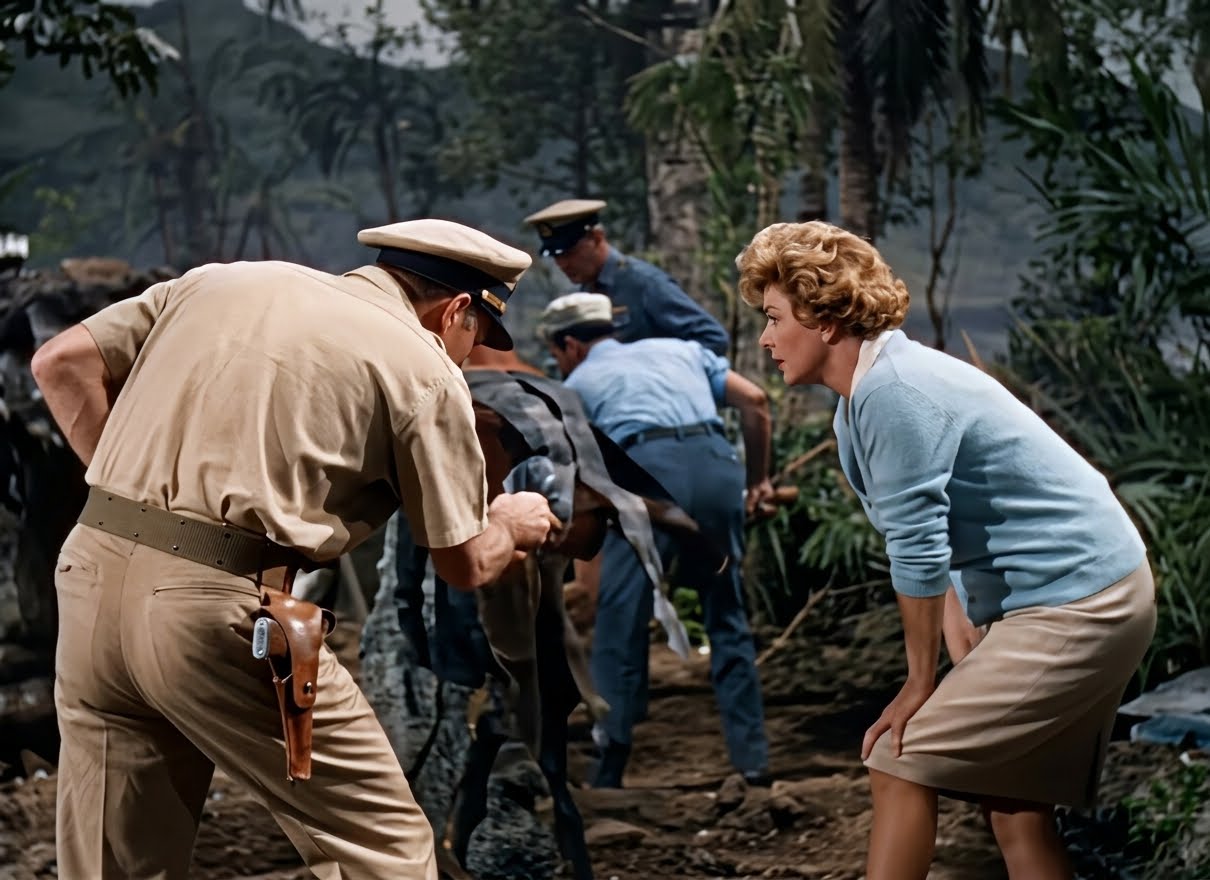
As for our leading lady, Mamie Van Doren and the case of the misplaced sweater, she was cast because she had a contractual obligation to appear in a Corman film, and Hoey decided to make the most of it. “So, I put her in a tight sweater and a pair of slacks about 50 percent of the time,” he later said, with a candour that could curdle milk. Her character, originally written as military personnel, became a civilian, possibly because the Navy wanted nothing to do with this movie. She does her best, but when surrounded by rubber trees, gooey corpses, and lines like “Those trees are alive!”, it’s hard to act when the scenery is quite literally eating itself. Though, to be fair, her male “love interests” are even less believable than the killer plants.
 The acting here is more wooden than the trees.
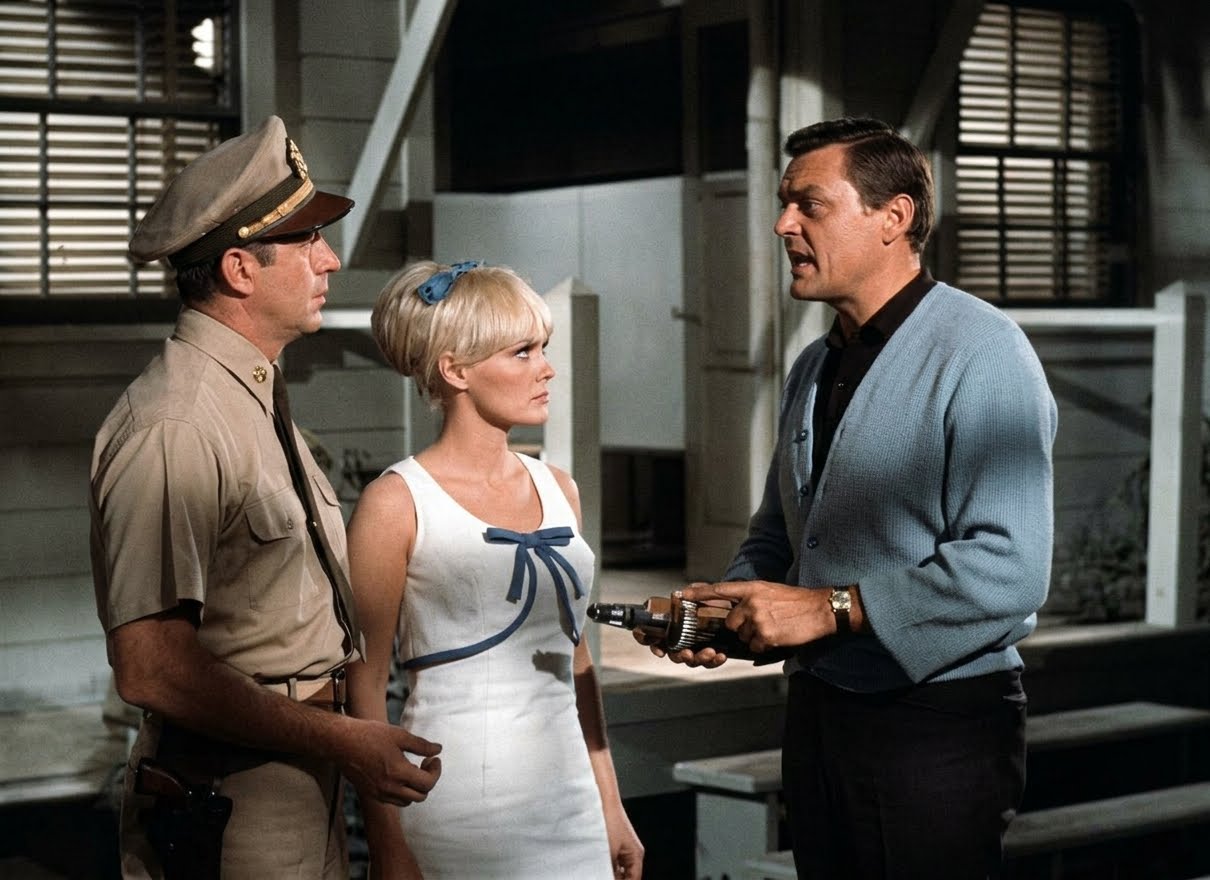
In conclusion, The Navy vs. the Night Monsters is the kind of movie that makes you appreciate the fine art of competent filmmaking. It’s an unintentional comedy dressed up as a monster thriller, a film that aims for suspense but lands somewhere between confusion and giggling disbelief. Michael A. Hoey’s ambition to make a smart sci-fi horror film was drowned in studio meddling, bargain-bin effects, and a title that doomed it to ridicule before a frame was shot. Yet, despite all its failures—maybe because of them—it’s oddly entertaining. It’s the cinematic equivalent of watching a drunk magician accidentally set his hat on fire: you can’t look away, and part of you hopes he pulls something miraculous from the flames.
The Navy vs. the Night Monsters (1966)
Overall
-
Movie Rank - 3/10
3/10
Summary
Michael A. Hoey’s The Navy vs. the Night Monsters is a clumsy, charming disaster/monster movie that fails at horror, science, and logic, but triumphs at unintentional comedy. Come for the killer trees, stay for the sheer audacity of calling it “The Navy vs. the Night Monsters.”