

Tarzan, Sherlock Holmes and James Bond have each been portrayed by several actors and with vastly differing styles, but to me, Godzilla stands above all as being the most varied movie icon of all time. So today, we will take a look back across the ages at the many incarnations of Godzilla to see what makes him the King of the Monsters.

The Godzilla franchise is typically divided into several distinct eras, each reflecting a shift in tone and storytelling. The Shōwa era (1954–1975) begins with the sombre, nuclear allegory of the original film before gradually evolving into lighter, more fantastical entries where Godzilla often plays hero against increasingly bizarre foes. The Heisei era (1984–1995) resets the continuity, returning to a darker, more serious tone with ongoing storylines and improved special effects. The Millennium era (1999–2004) experimented with standalone reboots, each offering a fresh take while often reconnecting to the 1954 original. Finally, the Reiwa era (2016–present) embraces modern filmmaking techniques and themes, ranging from the stark political satire of Shin Godzilla to the large-scale spectacle of the MonsterVerse, proving that the King of the Monsters can still evolve without losing his destructive edge.
 Gojira (1954)
But where did it all begin? Well, the original film was an answer to the popularity of such creations as King Kong (1933) and The Beast from 20,000 Fathoms (1953), so Japan gave us Gojira (Godzilla for American audiences), but this Toho monster movie was of a much darker tone than its predecessors. This move was a nuclear-fuelled allegory for the horror of Hiroshima and Nagasaki, focusing on man’s responsibility when it comes to creating weapons of mass destruction. The film is full of haunting images of people fleeing from the creature’s atomic fire or later dying from radiation poisoning. Such bleak elements are pretty much abandoned in the later films.
 “Don’t cry, we’ll be with daddy soon, just a few more minutes, and we’ll be with daddy again.“

Unable to match the effects budget of films like The Beast from 20,000 Fathoms, Toho Studios decided to forgo the costly stop motion process in favour of the man in a suit technique, and this is probably the weakest element in the 1954 film, as even though the rampaging action is great, some of the shots of Godzilla’s head are a bit goofy in its puppety way.
 “Hey, you guuuuuys!”

The Shōwa series (1954 -1975) With but a few exceptions, the Godzilla films of this era are as divorced from the original as one can imagine. Gone is the dark shadow of Hiroshima, replaced by a Godzilla who, though still a rampaging monster that causes untold destruction, has become a bit more light-hearted and, up to a point, even reaches anti-hero status. In many cases, he is a saviour of mankind as he battles creatures such as Ghidorah, the Three-Headed Monster, an alien menace and a greater threat to the world. If you thought Godzilla looked a bit goofy in some shots in the original, those moments are nothing compared to his “Victory Dance” after defeating King Ghidorah in Invasion of the Asto-Monster.

It’s hard to tremble in awe and terror before a giant behemoth if said behemoth is doing an Irish jig. Now I’m not saying there were no dark moments during the Shōwa years, as some of his battles got downright bloody with arterial spray going everywhere, and in films like Godzilla vs Hedorah (aka The Smog Monster), we see toxic sludge killing countless people, including babies, yes, babies! Of course, moments like that are undercut by shots of Godzilla holding his tail and rocketing through the sky.
 “Dignity, always dignity!”

In 1977, Marvel Comics got the licensing rights to publish a Godzilla: King of the Monsters comic and in this 24-issue run, pitted Godzilla against various foes from the Marvel Universe, with “Dum Dum” Dugan Agent of S.H.E.I.L.D., tasked with bringing him down. In most cases, Godzilla is portrayed as the lesser of two evils, and as in the case of the Shōwa years, he is more a reluctant hero than a villainous monster. It also leads to one of the greatest moments in the history of Godzilla, where everyone’s favourite atomic lizard is shrunk and sneaks around New York City in a trench coat and hat.
 “Leapin’lizards!”

Godzilla: The Animated Series (1978-1981) was co-produced by Toho and Hanna-Barbera Productions and pushed Godzilla even further into full-on good-guy status. The show followed a group of scientists who travelled around the world via a hydrofoil research vessel, investigated strange events that were usually monster-related, and whenever they got into a jam, the Captain would press a button that would summon Godzilla.
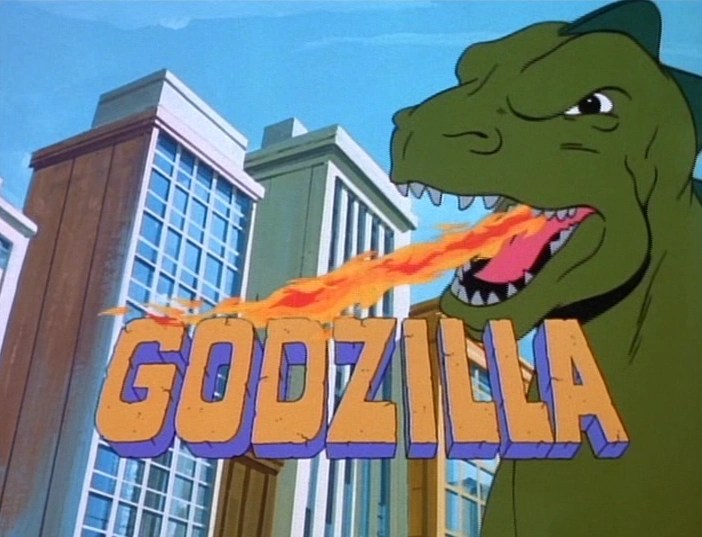
This cartoon is most known for bringing the world Godzooky, who is basically this show’s Scooby-Doo as he’s a smaller version of Godzilla, but there mainly there for slapstick comedy. Godzooki was for those who didn’t think Godzilla’s son Minya was annoying enough. Watching the show one wonders if they called Godzilla for anything else but rescuing. I know that if I had a button that called Godzilla, I’d be using it all the goddamn time.

The Heisei series (1984–1995). It is in 1984 that we get his first big reboot, in which we are told to ignore all the sequels that came before and that The Return of Godzilla is a direct sequel to the 1954 original. Back is the destructive Godzilla, and also back are the darker themes and tone. In this series we also start getting some really boss Godzilla suits, and he takes on some really amazing adversaries such as the new and improved Mechagodzilla, Space Godzilla and my favourite being the awesome plant monster Biolante. Who can but love a creature created from combining Godzilla’s cells with genetically mutated plants and the soul of the scientist’s dead daughter?
 Godzilla vs Biolante is mad science at its best.
The Millennium series (1999–2004) This series is interesting as almost all of them are stand-alone reboots. Each film of these films, except for Godzilla: Tokyo S.O.S., are considered to be direct sequels to the 1954 original. These movies are much in the same vein as the Heisei series, as Godzilla is still a terrible force that plagues mankind, but when something nastier comes along, it’s lucky for mankind that Godzilla is around to kick its ass. For me, the standout in this series is Godzilla, Mothra and King Ghidorah: Giant Monsters All-Out Attack, where it is discovered that Godzilla is imbued with the lost souls of those who died during World War II and who are angered that their sacrifices have been forgotten. Now they want to destroy Japan.
 He’s got those Evil Dead eyes.

Enter Dean Devlin and Roland Emmerich with their CGI travesty. There aren’t many good things that can be said about the 1998 Godzilla film; Matthew Broderick was horribly miscast, Maria Pitillo as the ex-girlfriend was beyond annoying, and the creature itself just wasn’t Godzilla. And I’m not saying that because it wasn’t a man in the suit but because it just wasn’t Godzilla.
 Godzilla (1998)
The design was more angry iguana than atomic-fuelled dinosaur, and he didn’t fucking breathe fire! If you have found yourself making a Godzilla film where at no point does he unleash atomic fire on his enemies, you have made a grave mistake and should retire to making romantic comedies about fish.
Sixteen years later, Gareth Edwards shows the world that you can do a decent CGI Godzilla.
 Godzilla (2014)

Now, in 2014, Godzilla has Hollywood going for the millionth reboot in the franchise to see if maybe they can get it right this time. Taking a page out of the Millennium series, they depict Godzilla as a violent force of nature and then pit him against some other giant, nasty monsters. There is something in this film about an EOD soldier trying to get home to his wife and kid, and who occasionally runs into some of the giant monster action, but really, who cares about that shit when we have Godzilla smackdowns to watch. In this film, we may not get a lot of monster-on-monster action but what we do get is pretty damn spectacular, and it certainly has me eager to see the next installment in the Legendary Godzilla series.
 So there you have it, a quick look at the history of everyone’s favourite atomic lizard; he started out as an allegory for the dangers of nuclear weapons, drifted into some series of goofy camp stuff, and then took a long trip back to being a dangerous badass. Here’s hoping for sixty more years of Godzilla!
The Many Faces of Godzilla
Overall
-
Franchise Rank - 8/10
8/10
Summary
Godzilla has mutated almost as much as the radiation that supposedly created him, shifting from a grim post-war allegory about nuclear destruction into everything from campy superhero monster to global blockbuster icon. Across decades of films, TV shows, comics, and reboots, he’s been reinterpreted repeatedly while still stomping through cities like it’s the one consistent personality trait he can’t evolve away from.